Category Archives: Dance

Savion Glover’s “Bare Soundz”

Photo by Nina Glover

Savion Glover is the best tap dancer alive. His mentor Gregory Hines thought so. On Saturday night, Glover, Marshall Davis and Robyn Watson performed “Bare Soundz” on three mini, square platforms in the form of a triangle on the stage at the Valley Performing Arts Center on the campus of California State University, Northridge. It was as if each audience member had received a golden ticket to attend the greatest tap jam on Earth — 80 minutes of nonstop tapping, including improvised solos, group choreography and trading bars.

Glover champions a new school of tap thought: all tap, all the time. Unlike Hines and another mentor, Sammy Davis, Jr., Glover focuses solely on tap. His feet are his instrument. In fact, his whole body is his instrument. Sometimes he smiles; other times he contorts his face to reflect another emotion or impulse. His hands act as balancers, either swinging by his side or hovering loosely in the air, palms up or down, depending on what he’s trying to say.

Which leads me to two of Glover’s greatest contributions to the art of tap. He wants us to hear the music in tap, but also be aware of the conversation. At times, his tap sequences sound like the heaviest rainstorm. And yet, what we hear is probably different than what he hears, or what he’s telling us. The rhythms he performs differ so subtly, it’s difficult for the average listener to comprehend just how sophisticated his sense of timing is and how complicated his thoughts are. His tapping has reached a level beyond entertainment. In Glover’s capable hands, and those of his partners on stage, tap becomes a form of communication, an outlet for expression, which is best demonstrated when the three dancers trade bars on the same small platform. They appear to be having a ball, sharing jokes, posing challenges and experimenting with new steps.

After a night of taps pounding and sweat pouring, I couldn’t help but think I had witnessed a cool, new millennium version of the bionic man.

Article on Culture Spot LA

Ronald K. Brown’s “Evidence, A Dance Compay”

Photo by Kurt Leggard

I often wonder, which is harder: exhibiting refined technique accrued from years of study, or grooving effortlessly to a beat with natural grace and impeccable rhythm? The answer depends on whom you ask. As I watched Ronald K. Brown’s “Evidence, A Dance Company” on March 9 at the Ahmanson Theatre, this question popped into my head. The 10 dancers on stage demonstrated hard-earned, well-polished talent. Leading the charge, however, was their mastery of establishing a visible connection with the music, of riding the tempos with soulful impact.

This seems to be part of the choreographer’s mission, and kudos to Brooklyn-based Brown for combining vernacular with modern, African, Latin American and Caribbean dance. Brown’s work has one foot firmly rooted in the past, while the other is in step with the present. Proving himself a risk taker, he chooses to elevate everyday movement to the professional stage.

A dance instructor recently informed me his own teaching process relies on his students’ intelligence upon arrival in his classroom, intelligence they have gathered by experiencing life. People see their parents or family members dance, attend religious services, boogie at barbeques or Bar Mitzvahs. Everyday movement can inspire dance — even be dance. The show’s first act, “Ebony Magazine: To a Village” (1996) is a perfect illustration. The audience feels as if it is observing an intimate conversation the dancers are conducting with themselves and each other using body motion in lieu of words.

Stevie Wonder’s classic catalog powers the second act: every song in “On Earth Together” (2011). Spectators bob their heads to “Living for the City” and romantically reflect on “You and I.” Brown and his nine counterparts flirt with interpreting Wonder’s music, grounding their movement in real-world reflections. Brown’s work is refreshingly accessible.

Some people attend dance to be wowed by physical feats only a select few can do. “Evidence’s” performance offers a more humanistic element. Nothing expresses this more than Brown’s own smile, a wide grin that beams infectious joy and sweet satisfaction. He’s not as young as the rest of his crew (he’s 46), but he exudes a command of his own action and choreography that is unmatched on stage. He owns his work.

In “Grace” (1999), the third set, Brown touches on the sacred. Yet I couldn’t help recall how the first act also has a spiritual tone, or that Wonder imbues “On Earth Together” with ethereal vibes. With dance, it can be hard to decipher the line between the secular and the sacred. The celestial feeling of performing or watching dance can make you forget your feet are on the ground. Perhaps Brown was too ambitious in taking on Stevie. Besides a few missteps, Broadway’s “Porgy and Bess” choreographer brings dance down to Earth.

Article on CultureSpotLA.com

Krump on KCET

Photo by Dan Carino

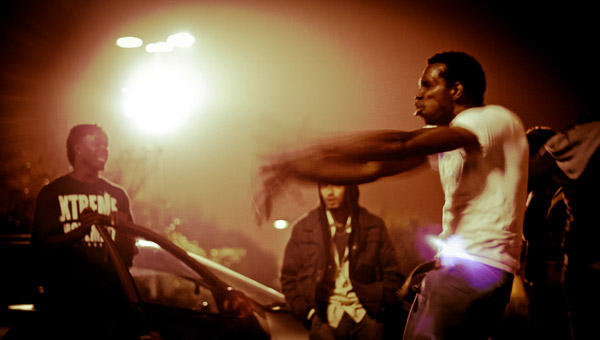
Around 2:15 a.m. a police car rolls up flashing its siren in a strip mall parking lot in the San Fernando Valley. The stores are closed. Few restaurants are open. The lot is empty, except for silhouettes gathered in a circle under a bright lamp. A parked car blasts hip-hop music through an open door. Some nod their heads to the beat, chest popping and foot stomping, waiting for a turn in the center. Others watch, chat, joke.

The car slowly approaches, then stops. It beams a spotlight in the group’s direction. Catching sight of the cops, a young man pushes the circle open into a half moon, giving them an unobstructed view.

“Let them see we’re just dancing,” he says. As the people part, a lone male krumper pops into view. Ignoring the cops, the dancer throws his arms to the sky, hops on one knee and bounces up again.

“Show them how you roll, Lil’ C,” someone yells from the circle.

If they recognize the soloist, the cops don’t show it. Lil’ C was one of the stars of Dave LaChapelle’s 2005 documentary Rize, and is seen on TV as a guest judge on FOX’s “So You Think You Can Dance.” Just following orders, the cops are determined to shut down the 818 Session, named after its area code. An officer shouts to the crowd through his megaphone that he has received noise complaints.

Lil’ C still doesn’t stop.

To read the entire article on KCET.org and see my re-edited video, click here