Category Archives: Uncategorized

Versa Style’s “Positive Dose”

Positive Dose/Sthanlee B. Mirador

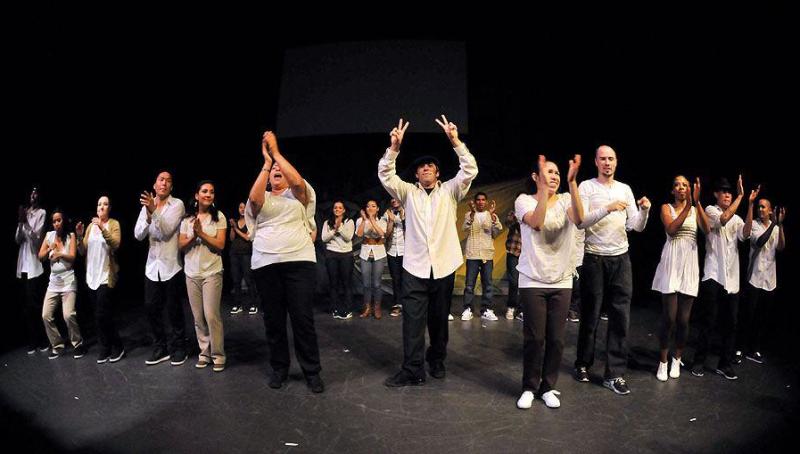
In the words of KRS-One, Versa Style’s six-run engagement of “Positive Dose” over the past two weekends was “edutainment.”

It was a true mind and body experience: The audience felt the kinetic energy of the hype dancers while meditating on the history of hip-hop dance within the larger context of the dance world, and of the power and meaning of dance within hip-hop culture.

The multimedia components of the performance were as captivating as the physical movements. Not to downplay the skill sets of the individual body movers, who each bring their own funk factor to the stage, but what really impacted the crowd was the video segments’ creation of historical narrative.

Opening the show was video footage of Rennie Harris, a hip-hop dance legend, teacher, and artistic director and choreographer of Rennie Harris Puremovement, who traced elements of hip-hop dance back to singer and bandleader Cab Calloway, tap dancers the Nicholas Brothers and all-around entertainment phenomenon Sammy Davis, Jr. Viewing footage of Sammy bouncing gracefully on the floor, kicking his feet to the beat, it is hard not to spot the beginnings of breaking.

Next, came a visually stimulating lesson on the huge influence of “Soul Train” on hip-hop dance styles and their increasing popularity.

Dancers became celebrities and the newly invented dance styles circulated the globe. Interviews with historical icons like Damita Jo Freeman, the first lady of “Soul Train,” put the past in the present’s lap, not only to celebrate the funk styles of that time but to acknowledge that today’s funk links to yesterday and inspires tomorrow.

The most vibrant elements of hip-hop culture—the spirit of inclusion, innovation, reverence and authenticity —were on display at the Rosenthal Theater at Inner-City Arts in Downtown L.A.

The first half of the performance was billed as “travelling into the roots of dances that have contributed to the rich hip-hop experience.”

Versa Style made each of us feel wealthy beyond words.

“Positive Dose” was more real than dance reality shows like “So You Think You Can Dance.” The multimedia presentations revealed the historical heart of hip-hop dance, and the cast on stage showed it to us, in the form of popping, locking, breaking, house and other popular funk and dance moves.

Dance styles will continue to change based on time, place and space, but they remain in conversation with the culture. Versastyle did an excellent job of recapping this conversation for people who knew and best of all, for those that didn’t.
Article on USC’s Neon Tommy

Left Out of the Story

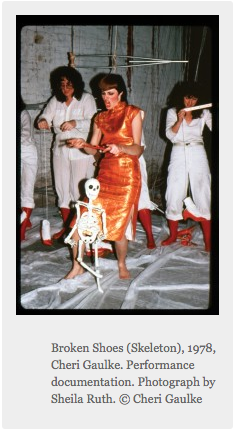
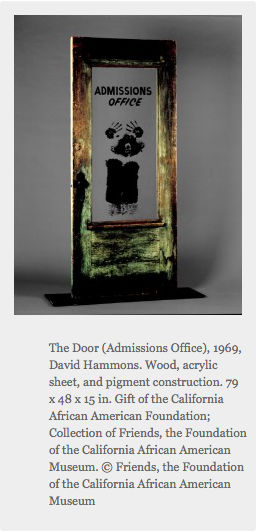
In the two posts I recently wrote for the Getty’s PST blog, which are up today, I found a common theme that has left me feeling awkward. In one I discuss black art and in the other black cinema, and in both I feel like the underlying thrust is, “Look at how surprising it was that these types of people, whether black or women, created this art at this time.” I think in both cases these sentiments were expressed in quotes from sources, and it is noteworthy to point these things out in a society that often overlooks the achievements of minorities and women most of the time. And maybe that should be my overarching concern, that we have to point out the achievements of women and minorities because it is not the norm.

Footloose Fails to Express a Love of Dance

Footloose missed a huge chance to do something great. It’s biggest mistake though was in the following scene. The main character is starting a petition to repeal a ban on public dancing in the small town that he was forced to move to after his mother died. His aunt comes into his room as he’s writing his speech to recite in front of the stiff governing body who passed the law and would have to overturn it, and she asks, “Why is dance so important to you?” “Because I want to stand out. I don’t want to disappear like everyone else,” he replies as he looks over at a photo of his mother. Yuck!

The more appropriate and realistic answer for me would have been to deliver a heartfelt monologue about how it is a release for pent-up emotions, a creative outlet, or anything that had to do with freedom, feelings, emotions and joy. The town was repressive and banning dance was just a part of it.

It’s not like we didn’t see this answer expressed in dance earlier in the film. The guy’s angry and frustrated at everybody in town for picking on him, and he drives to an empty warehouse where he dances wildly while he thinks of each irritating person and the infuriating thing they said to him in the past few days. If that outpouring of emotion in body form was expressed in words, that would have been the correct answer for auntie.

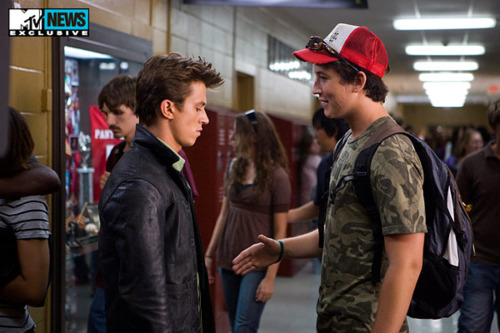
I picked this pic because the guy friend on the right is the best character in the movie.

The Krump Circle

Footage from Tee and my Oct. 12 visit to the Wednesday night krump circle.

Is Dance Performance Art?

I wrote a piece about LACE’s exhibition, Los Angeles Goes Live, for the Getty’s Pacific Standard Time blog. As I was clicking on my keyboard, I started thinking about performance art, and how I wish more performance art included dance. Or better yet, is dance itself performance art? I have never considered this question before this week, so hopefully, it will plant some seeds for future answers. LACE is commissioning one work by Ulysses Jenkins called Black Gold Fever on Oct. 13, which does feature dance. Maybe I should look into LACE’s list of events for more that include dance. But my gut tells me I want more. More dance, please! Which makes me think if the Getty is including performance art in PST, maybe dance could have been factored in. Or maybe it will be next time.

Tula Tea Room and Rooftop Garden: “Genius” Ideas

David Wilson of MJT

When I googled Museum of Jurassic Technology, I stumbled on a blog post on ARTINFO unearthing Yelp complaints about the museum. A few read, Avoid this place like the plague, and This place is just stupid, and the blog’s favorite, Your exhibits are old and falling apart. Your strange, but not strange fascinating. Strange like a hobo that I don’t want to talk, too.

David Wilson, the founder of the museum with his wife, has additional stories to share. “When people come here they have all different kinds of experiences,” he begins. Some laugh at everything they see. Or, he continues, “We have people who hate us. There are in almost all of our guest books places where people haven’t just crossed out their name when they leave, but they obliterate it. They make it so you couldn’t possibly tell that they had been here.”

To these disgruntled visitors, I say, “Have you sipped tea and nibbled cookies in the Tula Tea Room and relaxed in the rooftop garden? I cannot think of a negative thing to say about these two spots. For me, they are Wilson’s greatest accomplishments.

In 2001, Wilson scored a MacArthur genius grant and decided to invest in, among other things, a tea room and rooftop garden. Construction began seven years ago, and the spaces that wanderers see today are the result of budgetary constraints. He would have liked to do more.

Wilson wanted to expand the experience of the museum for some time, and he jumped on the award as a means to an end. “We have way too much text by normal museum standards,” he relays, “you just glaze over. We’ve come to understand there’s a need for respite.”

For inspiration, Wilson looked to other museums and architectural wonders, like the Sir John Soane Museum in London, the Sant Pau monastery in Barcelona and the courtyard of the Isabella Stewart Gardner Museum. “We draw on things that are inspiring to us. Our travels took us a few years ago to Uzbekistan, so a lot of this,” he says, looking around the serene, greenery-laden garden echoing the sounds of the spouting fountain off the walls, “is Uzbekistan.”

For the museum’s haters, I would agree with Wilson that, “Nothing is for everyone.” If you don’t like uncertainty, don’t walk this way. “I don’t mind being confused,” assures Wilson. “I think it’s an illusion to think you really know things. You can claim an area, but do you really know? Where was it you came from, ultimately? You don’t know. That’s a lot truer. Some people, understandably, don’t like to be in that place. Those I think are people that don’t like us. And that’s O.K.”

“For certain kinds of folks, a certain particular way of knowing seems like the real hope for the species,” Wilson goes on. “That by knowing things in a certain way we can overcome the obstacles of life, disease, natural disasters. That should be the mission for the species, that kind of progressing of knowledge.” To the contrary, Wilson points out, “Many ways of knowing things ends up being a really valuable thing.” He often delivers sentences like this that read like mantras and affirm his belief in doubt, such as, Blurred boundaries are much more real, and I’ve spent most of my life confused.

The certainty-loving types would be wise to contemplate the purpose of any museum. Wilson explains that in 1984 when his place popped up, modern society was experiencing a crisis in museums. The digital age was dawning and the museum world was interested in what he was doing differently to appeal to people. Wilson even received an invite from the British version of the American Association of Museums to be the keynote speech at their conference. Wilson was so shocked that he wrote to them and explained they must have meant to request the other David Wilson, the past director of the British Museum who had just retired. No, they responded, they had meant him.

Rather than providing the entertainment for that night, as Wilson jokes, “Institutions were realizing what’s the place of the museum when you carry in your pocket access to information that is exponentially way beyond what any museum could present; what’s the place of the museum?”

In establishing the Museum of Jurassic Technology, Wilson has answered his own question: What would happen if he worked as hard as he did on his film work on something he cared about?

Photos of the Tula Tea Room and Rooftop garden

Wilson speaks about the garden

And about the naysayers

LA Stage Times Debut

Photo by Carlos Delgado

I recently wrote Todd Nielsen Returns to Robber Bridegroom at ICT for LA Stage Times, and I really tried to “circle the ideas” as Sasha instructed us, and have a “clear point of view”, as we’ve been discussing with David. What made it especially hard is not having seen any version of the musical in any decade. I tried to do as much research as I had time for, but I didn’t get a chance to read Eudora Welty’s novella, upon which the musical is based. This frustrated me a bit because I felt like I was right back in the workforce juggling deadlines and feeling rushed without enough time to conduct good research. But, I did approach this piece with the idea that I would focus on something (i.e., the director Todd’s philosophies about directing and about his opinion about the show’s underlying themes) and reveal more about the director than the show. Sort of like a look into Todd’s mind. How did I do?

Latino Laurence Olivier, Spanish Richard Pryor or “Ghetto Klown”?

John Leguizamo loves to talk about himself. His one-man shows (This is his fifth.) are like therapy. For the past 20 years, he has used the stage to contemplate, criticize, parody, purge and ultimately, forgive the important players in his life. Everything that has happened to him –– from pushing and getting pushed by Kurt Russell and Steven Seagal, respectively, to aggravating Al Pacino –– and everyone who has touched him ––his best friend-from-the-block RayRay, his old-lady acting coach with three hairs sticking up nicknamed Tweety –– have helped create who he is: a ghetto klown.

Born in the “scrotum of Queens, next to the penis of Manhattan” (he announces as he projects a show-and-tell map of the two boroughs outlined as genitalia), Leguizamo stumbled into acting at the urging of an exacerbated math teacher. After reading plays by the greats like Sam Shepherd and Miguel Pinero, he saw that fucked up lives could be put down on paper. Another central epiphany to Leguizamo’s life output happened when he realized he could hide behind characters, whether of someone else’s design or his own. The hip and handsome manboy reveals what most of us have figured out about him at this point in his career; he transformed his destructive impulses into creative ones.

Much of what Leguizamo talks about in “Ghetto Klown” is not new. We’ve seen caricatures of his family and pieces of his life in his previous plays. His personal story of a struggling actor struggling with issues surrounding auditioning, ego, improvisation and rejection,is not unique, either. But it’s John Leguizamo that’s fresh each time he steps on stage. He is part hip-hop, Colombian, celebrity, father, lover and more, and he delivers his fast-talking tales and hyper antics in the form of raw comedy, music, multimedia projections, dance moves and hilarious imitations.

Leguizamo trash talks his fellow costars, embarrasses his closest family and often provides political insight, like when he explains what he calls subjugation architecture by projecting a picture of a school that looks like a jail and a jail that looks like a school, both in New York City. One of the most pleasant surprises of the show is sifting through Leguizamo’s large body of work. From his first role as a drug dealer on “Miami Vice” in 1984 to his scoring his own variety show, “House of Buggin’, in 1995 on FOX, to the plethora of big and small TV and movie roles he has racked up, his prolific catalogue might surprise many of his everyday fans.

Throughout “Ghetto Klown,” Leguizamo tries to give us a glimpse of his “internal jihad”, how every time he spirals and hits rock bottom, he bounces back with a spring of inspiration. His constant search for love and approval is satisfied through exhibition and audience connection. As Leguizamo affirms continuously throughout the night: “Sharing my unhappiness on stage is my happiness.”

Article on USC’s Neon Tommy

4th Annual J.U.i.C.E. Hip Hop Dance Festival

Amy “B-girl CatFox” Campion with Emiko Sugiyama

J.U.i.C.E. is not your ordinary hip-hop dance show. The annual one-nighter is more like a showcase of works in progress covering a variety of hip-hop-inspired dance styles, from old school lockin’ to new school krumping. The common thread that runs through all of the pieces is passion; and the celebration of peace. While the non-profit arts organization J.U.i.C.E. (Justice by Uniting in Creative Energy) pushes peace year-round, this event is specifically dedicated to the concept in the themes of the dance and emcee performances and call and response of the host D. Sabela Grimes. “When I say peace, you say peace.” “Peace.” “Peace.”

At its core, tonight’s hip-hop fest is about the kids. It might seem ironic that a dance form obsessed with battling can provide the foundation for community unity. But this is exactly what J.U.i.C.E. encourages. The fest’s performances are fun, gimmicky and brimming with creative costumes from superheroes to comic book characters. Oftentimes the visuals overpower the dance, confirming that the show’s producers are well aware of the short attention span of their largely young audience. The crowd (parents, too) seems delighted by the imaginative outfits of Buddha Stretch, Westbound and Antics Performance, and the cutesy skits of Baby Boogaloo and his mini b-boy crew.

A few of the groups rise above the kiddie culture. Host D. Sabela Grimes, who subtly shows off some of the best moves of the night, succeeds at appealing to both young and old. Serving as a bridge between the generations, he flirts with those who know what flirting looks like, and cool to all the rest with his big, gold Vlado kicks. But the hugest highlight of the evening appears in the middle of the second act. Four fellows, Shiyoshi featuring Kiminari and Kairi, boogie to the beat, showing off poppin’, lockin’, breakin’ and straightforward hip-hop choreography. Fluid and fierce, the rhythms direct their bodies as if the two entities (beat and body) are in intimate conversation. As part of the night’s promise of peace, Kiminari and Kairi will deliver 1,000 Origami cranes that the audience makes to the Children’s Peace Monument in Hiroshima, Japan, on Oct 7.

One act that impresses every year with their incredulous feats of physical strength, flexibility and grace is Lux Aeterna. Led by Jacob “Kujo” Lyons, the co-artistic director of the J.U.i.C.E. fest, the five seemingly non-human men and women balance on each other’s body parts, lift each other in jaw-dropping formations and wind and twist around each other like ripped ninjas. It’s slow, still movement that broadly interprets what hip-hop, or dance for that matter, is. Rather, it rests in its own locomotive universe somewhere between gymnastics, weightlifting and rock climbing. Amy “CatFox” Campion, the other co-artistic director of the J.U.i.C.E. fest, stands out in her Antics Performance troupe, as she does in any group, as the badass, tiny, hard-rock dynamo who can b-boy with the best of them. She hides herself in a massive swirl of motion, lost in a blockbuster fight sequence in which the whole overpowers the individuals, who each bring their own unique set of skills to the floor.

The Versa-Style Dance Company looks like they are having the most fun. Swinging to a song and style they call home, they smile with their feet and play with each other like they’ve been doing it for years. Simply dressed and round-the-way looking, they make synchronizing a funky bunch look easy, when you know it’s not. The motley crew is the perfect wrap-up for the show.

J.U.i.C.E. shows kids that dancing is a creative outlet that’s fun to watch, but even more fun to do, every Saturday from 12 p.m. to 4 p.m. at MacArthur Park Recreational Center. There the youth can decide: To B or not to B-boy.

Article on USC’s Neon Tommy

I love it – now that I am “officially” studying dance people are sending me interesting videos. Like in the previous videos I posted with classical music playing, I don’t like this song particularly (dubstep?), but I can see that the rhythm and beats are perfectly in sync with the dancer’s body movements. It’s as if his body and the song are each instruments in an orchestra, matching up to create a magical composition. Like in the Dancing in the Rain video I posted below, I am amazed at how easy this dancer makes what he’s doing look, but how incredibly hard it actually is. Many of the street dancers I admire have no official training. They just practice and perfect their skills on their own. It just comes natural…