I wrote up a Know Your L.A. Hip-Hop Dances blog for L.A. Weekly about Manny Fernandez, a krump dancer who was hit by a car, leaving him with a concussion and broken left leg. He returned to the 818 Session three months later.
My latest Know Your L.A. Hip-Hop Dances blog in LA Weekly on popping.
About three-quarters of the way in, the musical “Fela!” delivers the emotional impact of a bellyflop. It’s the all-too-familiar horror story heard around the world: Big guys take advantage of little ones. Woman raped, man beaten, man killed, woman harassed and intimidated. It could be Laos, Lagos or Los Angeles. The rich and powerful bully the poor, weak and politically dissident. In the case of “Fela!,” now playing through Jan. 22 at Center Theatre Group’s Ahmanson Theatre, terror reigns down on Afrobreat legend and activist Fela Anikulapo-Kuti, played by Sahr Ngaujah (Adesola Osakalumi is his alternate), his followers and fans in his home of Lagos, Nigeria, for standing up to the powers-that-be for freedom from corruption.
Fela’s acts of protest on behalf of his country, and all of Africa, threatened the legitimacy of the region’s oppressive military rule. He was jailed more than 200 times, and his mother Funmilayo (Melanie Marshall), also an activist, died from injuries suffered after being thrown from a second-story window. Interwoven throughout the exuberant African dance numbers and provocative catalogue of Fela’s popular grooves is the story of Fela’s political struggle, which rears its head in today’s Occupy movement. Heart wrenching and inspiring, his uprising enlivens the audience with the spirit of social justice.
Ahmanson audiences are led to believe they are sitting inside The Shrine, a nightclub in Lagos, Nigeria, in the late ’70s. It’s Fela’s last performance, and as he runs through his favorite songs, he chats with the crowd, shares his life story and rants about political malfeasance. The audience, at times, is commanded to shout out, sing along, and get up and dance. “Leave your shy outside,” Ngaujah orders, and adds, “Find your own groove wherever you are.”
Fela was determined to find his own voice through music; he traveled to London, New York and Los Angeles collecting sparks of inspiration, yet always returning to Lagos. The Tony Award-winning musical takes us on a tour of select parts of Fela’s life. “Drum is the pulse of the world,” he states. In “B.I.D. (Breaking It Down),” he and his dancers demonstrate the music-body-emotion connection. Fela transports us to different parts of the world as he discovers and creates his Afrobeat sound. He explains that he set out to “marry high-life to cool to jazz,” when, in an epiphanic moment, he meets an American named Sandra (Paulette Ivory), who introduces him to Black Power Man. The American political movement would influence his life’s work in Lagos.
“Fela!” is brave in its implications of the bad guys, from IMF and WTO to Halliburton and AIG. The book by Jim Lewis and Bill T. Jones alludes to exploitation at the hands of huge multinational corporations, and also chronicles specific instances by the Nigerian government. Ngaujah, who steps into Fela’s shoes magnificently, is cutting and clever when he calls out companies/governments for “419,” the Nigerian penal code for fraud, and explains that the colonial powers take/took “petroleum, diamonds and people” from Nigeria and give/gave “gonorrhea and Jesus.” Fela was opposed to colonial rule, but also to that of his own corrupt government, and those like his all over Africa. “Colonial mentality is a hard thing to break,” Fela laments; in his eyes, the Nigerian government seems to have perpetuated some of the same crimes. Lewis and Jones are bold in underscoring the continuing corruption into our current times.
What makes “Fela!” even more genius is that the creative team — which includes co-conceiver Stephen Hendel and Aaron Johnson and Jordan McLean who wrote additional music (Carlos Moore wrote the authorized biography Fela: This Bitch of a Life on which the musical is based.) — surrounds this larger narrative with entrancing African dance sequences and concert performances that keep the audience spellbound. Colorfully costumed in what appears to be traditional African style, the dancers pull off the most sensual moves as if they were easy as pie. This is one of the ultimate gifts a dancer can give an audience: making the movements look simple while having fun. Playful, often with attitude, and brimming with erotic confidence, the dancers move together, and alone, to the rhythms of Djembe drummer Rasaan-Elijah “Talu” Green and the entire onstage band. Their hips shake, sometimes faster than imaginable, their backs arch and spring forward, their arms and legs stretch, their knees bend, booties pulsing to the beat. If Jones’ choreography anchors “Fela!” in magnificence, the singing pulls it to the heavens. Ngaujah breathes new life into Fela’s own music when he performs it.
“Fela!” asks thought-provoking, rabble-rousing questions. Is Fela, or people like him, a nationalist or terrorist? In the final scene, “B.Y.O.C. (Bring Your Own Coffin)” the ensemble follows Fela’s lead in placing his mother’s coffin on the steps of the capitol. They carry small, wooden coffins with words on each one, such as “Rodney King” and “Sudan.” The last two coffins read “doubt” and “fear.” As Ngaujah told me five days before Los Angeles’ opening night, “What we are offering with our story is the highlight of having the courage to face your fears. If people have that, you can see a lot of things improved.”
Fela declares “music is the weapon,” and, as is the case for many arts activists, it appears to be an extremely effective one.
Article on Culture Spot LA

A scene from “Overlay,” Pennington Dance Group and York Dance Project’s collaboration in “Across Connections” / photo courtesy of Pennington
John Pennington began Saturday night’s show, “Across Connections” at ARC Pasadena, by introducing the dances in the program as nonlinear and without narrative. He was only partly correct. The statement appeared to be true for his company’s piece, “Yield of Vision,” and “Overlay,” its collaboration with the United Kingdom’s Yorke Dance Project. But from “City Limitless,” Yorke’s presentation, peeking out between the steps was a story, not of the traditional kind, but of joyful rebellion, stylish pursuit and self-discovery in the beats and words of American cultural icons. While Los Angeles-based Pennington Dance Group played with sounds and lights, creating delightful chaos, Yorke pushed their scenes along to a score of Dizzy Gillespie, Thelonious Monk and Charlie Parker and the poetic ramblings of Allen Ginsberg and Jack Kerouac.
From its opening scene featuring a duet with two men, to the swinging couples whirling around the stage, “City Limitless” spoke of the Beat Generation, On the Road and a time of youthful political leaning and social expression. Dressed in plaid and khakis, the attractive British cast interpreted a spirit in mid-20th-century American history that was bursting with cultural rebellion and possibility. Exciting and energetic, the dancers embodied this zeitgeist as sweetly as their flirty glances and playful embraces.
Pennington Dance Group’s “Yield of Vision” was a tad more brave new world-ish. In tight, silvery and sparkly costumes and makeup, the dancers stared at lights, turned them on and off and flitted around to the rapid ticking of a stopwatch. True to the night’s introduction, nothing made too much sense, without too much of a stretch, except maybe when Yvette Wulff floated on stage in what could be imagined as a spaceship outfit, and landed. It was soloist Li Chang Rothermich though, dancing alone and with Michael Szanyi, who told the most riveting tales with her compact frame, freezes and flexibility. Her face showed little emotion as she sped around with cold precision, yet Rothermich received a very warm reception.
Both artistic directors Pennington and Yolande Yorke-Edgell, who met as dancers in the Lewitzky Dance Company and have since maintained a long-distance working relationship, hope the program’s last piece, “Overlay,” is a first of what will be many collaborations. Existing in different places, the companies’ combined work lacked connection, between themselves and the audience. Each group performed in separate spaces, coming together at times, without clicking. It’s tricky figuring out how to make long-distance relationships work.
Article on Culture Spot LA
Every aspect of Tecnologia Filosofica’s Friday night performance felt surreal, from the venue – Theatre Raymond Kabbaz, which is attached to Le Lycée Français de Los Angeles – to the absence of English and the musical presence of a duo that resembled a tacky Las Vegas nightclub act. It was as if the price of admission bought you a ticket to another country. Flashing with European artistic sensibilities, “Canzoni del Secondo Piano” left many (Americans) in the audience amused and mystified. One thing was (pretty) clear: The quirky, nonlinear performance highlighted the happenings on the second floor of an apartment complex.
For more than one hour, Turin, Italy’s Tecnologia Filosofica accented the ordinary, making the particularities of living in cramped quarters relatable to all who have experienced it. Without words, the two female and three male dancers conveyed what it is like to flirt and socialize with, bump into, and feel crowded by neighbors, but also, in the midst of it all, feel totally alone. Welcome to the ups and downs of apartment dwelling.
Many of the show’s scenes were odd — perhaps because the irony was French and Italian, as were the songs accompanying each piece, and Americans aren’t always on the same humor page. Yet that didn’t stop the audience from thoroughly enjoying the kookiness on stage. One female, Francesca Cinalli, swung an apple on a string, trying to take a bite. She wore a yellow dress from which her nipple often poked out. Another woman, Elena Valente, clamped a celery stalk between her lips. Both ladies seemed to be longing for love, and not getting it from any of the males, who were engaged in what looked like a friendly game of Twister. When one of the male dancers, a playboy-ish Renato Cravero, finally took notice, he and the celery stalk-ing woman joined together, entangled in an absurd display of lovemaking.
Even more bizarre were the singer, Francesca Brizzolara, dressed in fishnets, black knee-high boots, a miniskirt, and a leopard-print coat with two rollers in her disheveled hair, and the musician, Paolo de Santis, a tad more flashy with black leather pants, a black-and-white-print button-down, and a cheesy mustache. The two seemed plucked right out of a dive bar in any down-on-its-luck town, making funny faces and even sillier gestures to the crowd and into a video camera in front of them. She sang in French and Italian, while he tickled computer keys and played a kazoo.
The most precious part about “Canzoni del Secondo Piano” was how unprecious it was. The piece celebrated average bodies and everyday senses of rhythm. Some people like to move. Some are really good at it. These dancers did not perform anything amazing or near impossible. Instead, they had fun playing with beats and moving in unconventional ways. That makes them dancers. For Americans, who have become used to viewing spectacles and feats of grandeur, it’s refreshing to see people making a dance out of everyday life.
Article Posted on Culture Spot LA
Wow. I saw “Fela!” last night at the opening in Los Angeles. But before I did, I interviewed Sahr Ngaujah, who portrays Afrobeat legend and political activist Fela Anikulapo-Kuti, and has since the show’s 2008 Off-Broadway debut, and LA Stage Times published the article. The show was amazing as was Sahr. Stay tuned for my review, which will be posted shortly.
DancesMadeToOrder: “Pursuit”
Antics Performance at J.U.i.C.E. 2011:
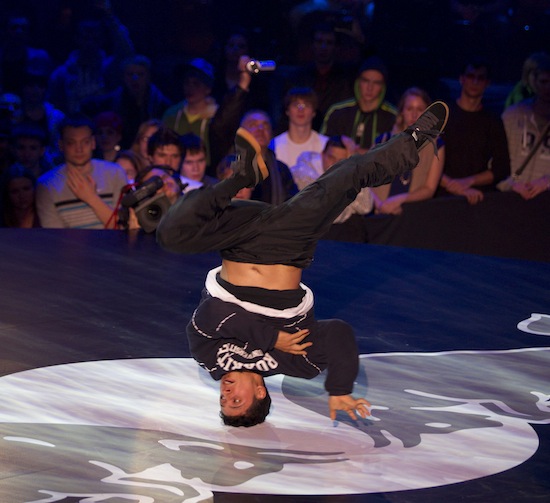
Bradley Rapier, founder of the Groovaloos and street dance instructor at various locations, including University of Southern California, illustrates some hip-hop dance styles, from popping to party, while one of his students shows off his breaking skills. For more information on the Groovaloos and Bradley, visit bradleyrapier.com, groovaloo.com and groovaloos.com.
Breaking: Emerged from the South Bronx in the early ’70s and revolves around of a number of movements, mainly Toprock, Uprocking, Power Moves, Footwork and Freezes.
Locking: In the late ’60s in Los Angeles, while trying the Funky Chicken, Don Campbell inadvertently created what is now known as a “locking” motion, or freezing to the beat. The art form is loose and extremely funky, yet crisp, strong and athletic at the same time.
Party: A variety of simpler dances reflecting the music and culture of the time that influence the larger street dance disciplines with names like the Freak, the Rock, the Gigolo, Running Man, Roger Rabbit, Robocop, Rooftop, Reject and the Dougie.
Popping: The contraction of muscles to create a pop or hit with the body, hailing from Fresno in the mid-late ’70s.
Popping – Electric Boogaloo Style: Adds twist-o-flexs, rolls of the hips, knees, legs and head, and boog style to the vocabulary of popping.
Rocking: A style of dance that preceded and greatly influenced breaking from New York City, specifically Brooklyn, which features a back-and-forth rocking movement than often accompanies foot shuffles, spins, turns, freestyle movements and a four-point, sudden body movement called “jerk”.