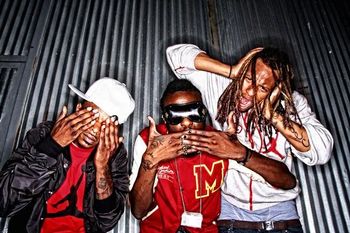
The Rej3ctz, from left, Pee W33, MoWii and Bounc3/Photo By Pierre Auroux
Here’s my third installment of my LA Weekly Blog called Know Your L.A. Hip-Hop Dances on The Cat Daddy.
The Rej3ctz, from left, Pee W33, MoWii and Bounc3/Photo By Pierre Auroux
Here’s my third installment of my LA Weekly Blog called Know Your L.A. Hip-Hop Dances on The Cat Daddy.

Magno Rubio (bottom center)/Photo by Hydee Abrahan/Studio 1003
Magno Rubio is small; both the man and the play titled “The Romance of Magno Rubio.” As the cast yells out in unison at the start of the show, “Magno Rubio, four feet six inches tall. Magno Rubio, dark as a coconut ball/With a head small/And limbs like a turtle.” The belittling words set the stage for the conflict ahead. Magno Rubio (Jon Jon Briones) is a tiny man in love with a large woman and a huge dream, for which his fellow Manongs – Filipino migrant workers – constantly tease him. Audience members at [Inside] the Ford in Hollywood not familiar with how Manongs were treated in 1930s California get the picture as they take their seats and the words ‘No Dogs and Filipinos Allowed’ graffitied on a wall stare them down.
Despite the show’s sparse set and small space, “The Romance of Magno Rubio” packs a big punch; the impact of which is most glaringly felt when the labor camp’s overseer shoves to the ground a Manong named Atoy (Eymard Cabling), who had paused picking fruit because of the rain. He hits him with a switch and commands him to get back to work. It resembles the way black slaves were beaten on plantations, and it highlights America’s recurring, cruel reality of exploiting minorities through an economic system that survives on cheap labor and inhumane treatment of workers. This is a familiar story, this go-round from a perspective that is not heard much, if at all, and especially not in Tagalog, a language native to the Philippines. Director Bernardo Bernardo has adapted Carlos Bulosan’s short story into two languages: English and the Tagalog version, “Ang Romansa ni Magno Rubio,” which runs twice on Saturdays.
The show’s message is clear, and rears its heads in spoken words like, “The American dream loves someone else” and “United Snakes of America.” Magno’s dream is personified by a “girl twice his size sideward and upward.” He picks her out in a magazine’s Lonely Hearts section and maintains his faith that their affection is mutual. Clarabelle (Elizabeth Rainey) lives in Arkansas, and the two lovebirds correspond regularly by letter with the help of his friend Nick (Giovanni Ortega), whom Magno pays for his script services. Magno works nonstop and naively sends every penny he earns to Clarabelle. Her response is always the same: It is not enough. Send more. Work harder. Leave nothing for yourself. Missing the point completely, Magno clings to the idea of her love and their impending marriage.
“The Romance of Magno Rubio” is a commentary on exploitation, disillusionment and dashed hope that today speaks to just about everybody. For Magno, receiving Clarabelle’s imagined love is equivalent to achieving acceptance and success – what his new homeland promised upon his arrival. His faith in the unseen is what sustains him, what sets him apart from the others, allows him to maintain cheer in the face of hardship.
What also supports Magno and his forlorn migrant crew is spirited song and dance. As did many black slaves, the Manongs fill their days and nights with rhythms – traditional Filipino love songs called Kundiman – and movement – eskrima, or martial arts using rattan sticks. Again, words are central; most of the dialogue is delivered in rhyme, a clever choice that sometimes adds silly phrases to this serious show, with good result.
Posted on Culture Spot LA
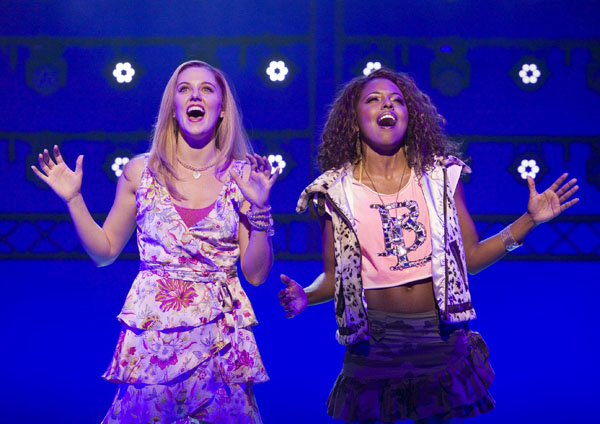
Taylor Louderman and Adrienne Warren/Craig Schwartz
I went into my interview for LA Stage Times not knowing that in September, the Writers Guild of America filed a request for arbitration on behalf of Bring It On screenwriter Jessica Bendinger, who claimed the musical’s producers “never acquired or received permission to use her exclusive rights.” The WGA was seeking damages and an injunction to halt the show until the producers acquired Bendinger’s rights. The first question I asked the stars focused on the film, and they denied the show had much to do with it. I immediately sensed they were defensive and changed the direction of the interview. It all made sense when I got home and found this information on the Internet.
 The term hip-hop dates back to the ’40s when African Americans would say they were “hip-hopping” when they went out on the town. Then again in the ’70s, Afrika Bambaataa referred to hip-hop as the culture he was championing that encompassed the four elements of deejaying, graffiti, emceeing and breaking. Hip-hop dance is very much a part of, and cannot be viewed separate from, the broader hip-hop culture, and often intersects with the other three elements.
While many of the dance moves and styles that are considered hip-hop dance are relatively new, their beginnings can be traced further back in history. In the ’50s and ’60s, tap dancer and all-around entertainer Sammy Davis, Jr. introduced fancy foot and floor work in his star-turning routines that influenced modern-day breakers.
The athleticism, virtuosity and flash of tap dancers the Nicholas Brothers, who caught Hollywood’s attention in the ’40s but who were electrifying stages in the ’30s, planted ideas about what was physically possible on the floor, in the air and using props for effect. The impact of other popular African-American entertainers of the ’30 and ’40s, like Cab Calloway and the Berry Brothers, can also be credited with influencing today’s hip-hop dance styles.
“What we now consider hip-hop dance is the most recent manifestation of a genealogy of dance practices that have been going on since African people came here,” explains D. Sabela Grimes, dancer, UCLA professor, creator of The Funkamental Movement Experience, and host of the 4th Annual J.U.i.C.E. Hip Hop Dance Festival.
Amy “Catfox” Campion, teacher, dancer, artistic director of Antics Performance and co-artistic director of the J.U.i.C.E. Hip Hop Dance Festival, adds, “Dance history is a continuum with various dance styles continually being born, disappearing, developing, evolving, and influencing one another.” She lays out three defining factors when speaking about street dance, a term she uses instead of hip-hop dance as an umbrella term for a variety of street dance forms, including Uprocking from Brooklyn, Breaking from the Bronx, Popping from the Bay Area, Locking from Southern California, Footworking from Chicago, Wu-tang from Philadelphia, Hyphy from the Bay Area, Jerking from Inglewood.
Street dance takes place in unconventional spaces. “It did not emerge in a class or dance studio,” Campion assures, but rather “in everyday spaces like a parking lot, playground, garage, backyard, or community center.” Second, it centers around freestyle, and third, it generally springs up in urban areas.
It seems clear that hip-hop dance is conceived in relation to time, place and space. Grimes adds to the discussion about the inception of hip-hop dances within social contexts. “What’s interesting about hip-hop dance in particular is that we often get caught on the surface level, like these are the hip-hop moves or hip-hop dances, and we don’t think about the social context in which these dances are created,” he offers, “about how the community intelligence, collective intelligence, really gives birth, depending on what urban environment you are in. They are regional, vernacular, corporeal body languages and vocabularies exchanged among people in certain communities that are very relevant to them.” He views hip-hop dance as a conversation that’s wildly popular because of its inclusiveness.
Bradley “Shooz” Rapier, dancer, award-winning choreographer and creator of the Los Angeles-based Groovaloos, says that traditionalists often refer to popping, locking, and breaking as the central styles of street dance. Popping and locking share their birthplace in California and are known as funk styles, a term coined by Electric Boogaloos member Popin Pete for West Coast street dance styles. Popping, or the contraction of muscles to create a pop or hit with the body, hails from Fresno in the mid-’70s, as does the closely related Electric Boogaloo, which adds rolls of the hips, knees, legs, and head to the vocabulary of popping.
Boogaloo Sam of The Electric Boogaloos is credited with coming up with the term Popping. In the late ’60s, while trying the Funky Chicken, Don Campbell inadvertently created what is now known as a “locking” motion, or freezing the arms to the beat. After receiving huge crowd approval, he named the style after himself, Campbellocking, soon shortened to Locking. He formed the world-famous Lockers, which included Toni Basil before she released her #1 hit “Mickey.”
Breaking emerged from the South Bronx in the early ’70s and revolves around of a number of movements, mainly the Toprock, the Downrock, Power Moves and Freezes. Most importantly, “b-boying began with the break,” writes author Joseph G. Schloss, “the part of the song where all instruments except the rhythm section fall silent and the groove is distilled to its most fundamental elements.”
As Campion points out, “Hip-hop dance can mean different things to different people, so one definition is challenging.” What’s clear is that each individual dance style maintains its connection to hip-hop culture as a whole.
 After Jonathan Gold left our classroom last week, I think I heard Erin ask Laurie Ochoa if our guests will ever give an actual answer to our question about how they do what they do (paraphrasing here). I also find it funny, but truthful, that our guests are all naturals at what they do. Gold told us he’s “wired weirdly,” and Powers said, “Things that people are willing to pay for come from my pen.” I believe you can become a great writer, but I also think it’s easier for some than others. And I also know that some people never consider any other career. I knew I wanted to be a writer since I was six. I went to a fortune teller on the Santa Monica Pier and after looking at my little palm she confirmed what I already knew; that I would grow up to be a writer.
Aside from being “a natural,” I think Gold shared some incredibly helpful advice with our class.
He gave us guidelines when writing about food (or most things):
• Write about what you are experiencing.
• The dish came from somewhere, exists somewhere and is going somewhere; tease out the narrative.
• Be like the man from outer space, but don’t over-exoticize things.
• Elegant variation is the number one enemy of writers.
• Write details that tell.
And my favorite piece of wisdom: There is a weird inner dialogue in your head when you’re experiencing something. Transcribe that inner voice. That’s what’s interesting. Your unconscious is writing the piece. Pay attention to that annoying inner voice.
I can’t stop thinking about this last tip. I went to a few shows this weekend and I kept scribbling throughout the performances. I even did as Gold said and wrote my comments down before sharing them with the person sitting next to me.

Come Fly Away/Joan Marucs
Last week, I saw “Come Fly Away” at the Pantages Theatre, and I loved it. I wrote a preview for LA Stage Times based on an interview I did with John Selya, dancer and resident director of Twyla Tharp Dance. Turns out he was a breaker in his youth and break dances during the show. I also wrote a gushing review of the show for CultureSpotLA. I struggled to write a rave review without sounding gushing. Looking back, I could have criticized a few things, articulated a stronger point of view and made connections to larger issues. Maybe I could have gone further than describing the scene and explained why this type of show with this type of movement without too much story is different, exciting or valuable.

Photo by Steven Schreiber
Kyle Abraham’s skill at picking dancers is as great as his talent for choreography. During the 75 minutes that The Radio Show tickled our senses at REDCAT on Oct. 21, the audience was treated to bodily perfection. It was a combination, of course, of gracefully rhythmic movements, subtly seductive outfits and bodies that boasted sculpted lines and alluring curves.
From first sight, the costumes piqued our interest and set the sensual tone. Like Academy Award winners for Best Costume Design Chariots of Fire (1981) and Gandhi (1983), The Radio Show wasn’t showy in its designs, but it still scored big. The pants and tops in shades of brown and gold appear rather plain-looking. Yet it’s the way they hug the dancers’ torsos and limbs, and their backs peek out of the gaping holes intentionally cut to showcase the soft, sinewy lines. In modern times when it seems as if we need so much to stimulate us, Abraham reminds us how surprisingly erotic an oft-overlooked body part can be.
What’s even more attractive than the coyly exhibitionist style of the clothes is the egalitarian nature of the audience’s desire. Men and women admire both male and female. It’s a dual sexuality that transmits back and forth between the standing and the seated. The female dancers are as imposing as the male, the men as elegant as the women. The seductive ambivalence throws everybody in the same boat, leveling the playing field and making each solo, duet and group performance an exhilarating, power-shifting balancing act.
Using the dancers’ bodies as his Etch A Sketch, Abraham weaves his feelings, surrounding the closing of a popular black radio station in his hometown of Pittsburgh and Alzheimer’s in his own family, into the movements that power the performance. From the beginning, as Abraham himself walks through the crowd, his arm twitching uncontrollably, it appears as if some form of expression is being repressed. Later in the piece, when he tries to scream but no voice comes out, the disconnect and loss are even more obvious.
Playing on the theme of a black radio station, the soundtrack to the show sings with old and new popular tunes from Betty Wright to Mary J. Blige, Bill Withers to Beyoncé. It’s an interesting move when choreographers choose to use familiar tunes. They run the risk of the nostalgia factor. The audience has its own memories attached to the tunes, and the songs are usually associated with a certain time. But Abraham also accepts the challenge of taking the audience somewhere they’ve never been before. His work does just that, existing within the terms of the music but also pushing beyond, fusing hip-hop, ballet, street jazz and modern into something fresh.
Complementing the choreography are the seven dancers (including Abrahams) who truly inhabit each step. They are longtime friends of the beat, and their relationship blossoms over the course of the show. The second act overflows with funk, as each member of the motley crew adds its own flavor to the joyous mix. These dancers are having fun, which can be felt throughout and continues even after the performers take their bow, at which point they break out into playful party moves as they exit the stage.
Abraham doesn’t completely rely on the familiar. One of his more surprising moves is toward the end, when Antony Hegarty’s operatic version of Beyoncé’s “Crazy in Love” lulls the crowd, turning a smash pop ditty into a tender, albeit grating, aria. It’s only fitting that Abraham once again turns convention on its head.
Article on CultureSpotLA

Hallelujah Junction/Paul Kolnik
To be completely honest, I’m a hip-hop dancer who considers herself pretty narrow-minded when it comes to other styles.
Sure, my parents took me to The Nutcracker when I was a kid, and I have seen several performances by American Ballet Theatre. But overall, my assessment of ballet was pretty bleak.
I am, however, on a quest to broaden my horizons and appreciate all that the world has to offer. To this end, I took a drive to CSUN this past Sunday to attend New York City Ballet Moves at Valley Performing Arts Center. To say that I was pleasantly surprised is an understatement.
For somebody who is usually lulled to sleep by strings and shutters when she thinks of the strict practice and eating regime the dancers have to abide by, I left this performance gleefully leaping through the air.
Never before I have I seen ballet dancers having such fun, or eliciting in me any feeling close to fun. Like a first date, the duets sparkled with young, playful love. It was not that refined romance I’m used to seeing on stage, but one of kids chasing each other, thrilled when they are caught. The group performances resembled party-like atmospheres. In “Hallelujah Junction,” Daniel Ulbricht was the stud at the center of everyone’s attention. When he circled the stage in twirling leaps, it was a no-brainer that he was leaving the scene with a pocketful of numbers.
In “Polyphonia,” the show’s opener, four couples gracefully yet speedily formed shapes with their limbs, striking a distant resemblance to the Village People’s “YMCA.” Without a narrative, the piece made me think harder about where to look. With four couples to follow, it wasn’t as easy as focusing on Sleeping Beauty. Another fresh factor in many of the pieces, this one included, was the emphasis on the piano. As mentioned above, strings seemed to be my downfall; piano was now my caffeine.
Being new to ballet reviews, I understand there is discussion over the meaning of “contemporary ballet”. On Flavorwire, Michelle Vellucci asks, “Is it a blend of modern and ballet? Could it be hip-hop performed in pointe shoes? Does cross-breeding ballet with other genres necessarily dilute the form, or read as a critique of it?”
I am now of the opinion that laying on the floor and performing movements that border on chunky blips and hand rolls up the side of the body enhance the form. The youthful energy of the Moves stars may have been the ticket to my newfound appreciation of ballet, but I also believe it was the feisty, festive attitude that shot through the movements.
With pep in their steps and smiles across their faces, this traveling cast of New York City Ballet made me think those New Yorkers are on to something.
Article on USC’s Neon Tommy

Photo by: Andrew Lang
Watching Hofesh Shechter perform their U.S. premiere of Political Mother this past Thursday night strangely brought to mind two related scenes in the recent release of the remake of Footloose.
Ren, the main character of Footloose, is starting a petition to repeal the ban on public dancing in the small town where he has relocated to after his mother’s death. The high school senior is not only good at getting down, but he obviously identifies dancing as something that’s good for the mind, body and soul. For Ren, dancing in public also represents an act of youthful rebellion and freedom that should be a right for the town’s teenagers, who are instead monitored, controlled and treated as untrustworthy delinquents. One afternoon when frustrated by all of the slack he feels like he’s getting for being the new, big city, bad boy in the repressive town, he drives to an empty warehouse and dances wildly, “pouring his heart out” visually.
This type of emotional outburst marks the powerfully charged atmosphere of Political Mother. Artistic Director Hofesh Shechter’s first full-length piece opens with a samurai performing hara-kiri, and follows a stream of handsome, plainly dressed dancers twisting, throwing, lunging, shaking, jumping, and skipping as they careen on and off stage. The music alternates between big rock and hard metal, and the conductor switches between a lead singer and a dictator. The music and dancers are fast then slow, loud then soft. A disconcerting sense of mania pervades Royce Hall, as dizzying music and shadowy lighting traps the audience and places them in the center of confusion, tragedy, militaristic angst and angry desperation. It is a chore to remain focused, and not tune out.
Keeping in time with the world we live in, and taking into consideration the choreographer’s Israeli roots, the message in the movements’ madness is whirling around the stage, screaming into the silent crowd. In the final scene, it physically appears as the backdrop: “Where there is pressure there is folk dance.”
What Political Mother expresses best of all is the immediacy, the need to take particular action, whether to kill, to control, to oppose, to release, to move. Dance becomes the weapon, the tool, the outlet, the expression of political desire. Politics is messy. Music is messy. Dance is messy. Political Mother is a chaotic mix of dance styles – Israeli folk, modern, breaking, krumping – an explosive burst delivering the emotional impact of an inspiring peace speech.
Which brings me back to my point about Footloose, and why I take such exception to the following scene. Ren’s aunt comes into his room as he’s writing his speech for the town meeting, and she asks, “Why is dance so important to you?” The teen takes amoment and replies, “Because I want to stand out,” adding, “I don’t want to disappear like everyone else,” as he looks over at a photo of his mother.
His answer misses the mark completely, and as a result, Footloose fails to express in words what Political Mother so successfully achieves on stage. The drive to dance derives from a place deep within an individual, and the tapping of that creative wellspring is liberatory. The urgency to express or release what is repressed or pent-up is essential.
Whether it is a town’s ban or a regime’s repression, the atrocities of war or the hardships of economic oppression, creative outlet through dance marches on. Movement as a survival technique becomes both beautiful and poignant, and the freeing of the body through dance is as significant to the spectator as it is to the performer.
Article on USC’s Neon Tommy
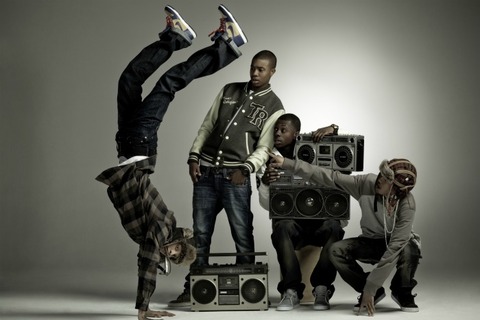
 Jessica Koslow