Jessica Koslow
A Running Commentary About the Arts
Category Archives: Uncategorized
Here’s another dance video that caught my attention. A dance professor/activist I really respect posted it, so I knew I had to take a peek. The featured dancer has amazing body control, but it’s the way he combines classical dance with a more contemporary street style, some form of krumping/popping/etc., that excites me. The hybrid reinforces my like of classical when it’s modernized with some form of street style.
Kindergarten krump
One of my goals while studying at USC is to focus on street dance. I have been a hip-hop dancer for about 15 years and a hip-hop journalist for almost as many. My love of hip-hop music has been unwavering but not until this year did I realize I could shift my critical focus from covering the music to chronicling aspects of the dance. Which brings me to this YouTube clip. For me, krumping or buck dancing has always been associated with adults. Rarely, if ever, have I seen youngsters move with such passion and precision. Since I dance myself and have recently taken a krumping class, I can personally attest to the difficulty of this style.
Building on my visceral love of street dance, I am also attending a seminar called “Black Popular Culture,” which will provide me with an academic lens to view the culture of street dance. After only two week’s worth of readings from this course, I am faced with questions, such as: Are these types of popular culture dances reinforcing positive/negative stereotypes of blacks? What societal factors influence these dances, and how do these dances reflect the larger society?
My Cool Cousin
My cousin Josh has been playing the trumpet since he moved here from Houston when we were both in junior high. He and my brother formed a group that played on Venice Beach called Boardwalk Jazz. He continued blowing at Hamilton High, where he met one of his current band members, Emil. He’s never “made it”, as they say here in Hollywood, but that hasn’t stopped him from playing. He’s a construction worker on some days and a musician at all other times. He made an album with his brother, a hip-hop beatmaker named Elusive, and he continues to travel back and forth between the jazz and indie hip-hop worlds. Recently, he has joined the underground bike culture of Los Angeles. I follow him as he posts pictures of his rides and new bikes on Facebook and I enjoy his stories of the miles upon miles that he rides with groups of other bike enthusiasts. He’s brought new bike friends to my get-togethers and performed at many cycle-related parties.
Last night, his mom posted this video (link above) on Facebook. I love it because it celebrates a youthful, upbeat, happy side of Los Angeles, the popular bike culture and a mellow mix of hip-hop and jazz that makes me appreciate both genres. Piggybacking on Sabrina’s theme that the politics of our time seeps into art, I think this video sends a message of the importance of alternative forms of transportation, especially in L.A., and by extension, of our need to clean up the environment. It puts a positive spin on biking. I’m sure there are down sides, but we only see the good: how cool and fun biking is. While the video may not be overtly trying to make a political statement, it succeeds in making a powerfully cool one.
Yo-Yo Ma and Lil Buck
After our discussions yesterday, which touched on opera, art, museums and dance, I immediately thought of the above video with Yo-Yo Ma and Lil Buck. I love krumping, but not classical music. However, when the two are combined, I’m interested. I feel a connection with Lil Buck’s organic body movements, even though the strings lull me to sleep. I feel a tad uncomfortable about the upper crust setting with the fancy-pants people, an environment in which Lil Buck’s dancing seems out of place, but I am also excited that the appeal of krumping is reaching beyond its borders. It’s a strange yet inspiring mix: Yo-Yo Ma and Lil Buck. And I think Spike Jonze, who presents this video on YouTube, realized how unique and rare this collaboration was and how well people might receive it.
This second video shows Lil Buck and Yo-Yo Ma visiting Inner-City Arts on Skid Row. I am assuming the two men were on a tour promoting arts education in schools. I like the message in both videos, but the second is less jarring to me, in large part because of the setting and audience.
The Green Goblin Car
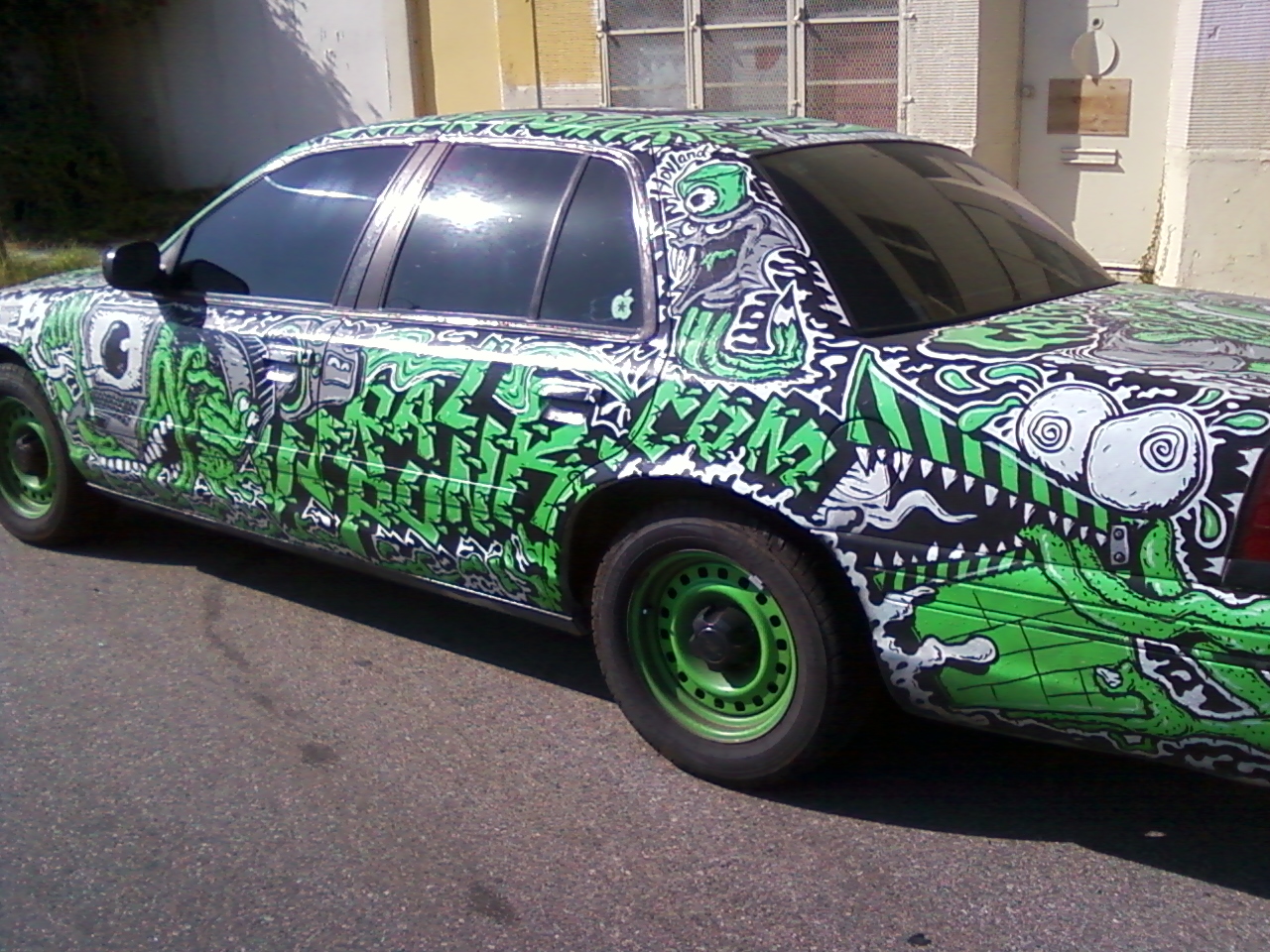
Parked car on Jefferson
I recently saw this car as I was driving down Jefferson and I had to stop, get out and snap a photo with my phone. I never do this. That’s how awesome I think this car is. I’m not crazy about the green and silver combination of colors, but considering it’s a car I can’t blame the owner for choosing not-too-alarming colors. Actually, I love green. What I like most about the car’s design is that it covers the entire body of the car, even the inside metal of the tires are green. It’s graffiti-inspired and conjures up gritty thoughts of sewers, boogeymen, monsters and goblins. I like that it’s grimy and feels like it might be the getaway car of a villain, possibly the Green Goblin.
L.A. Story Project: Robert and Selena Marie Amado at Homeboy Industries
Homeboy Industries is the largest gang-rehabilitation center in the U.S. Former gang member Robert Amado was released from prison just over one month ago after serving 14 years. When he went in, his daughter, Selena Marie Amado, was two. Now she is 16.

Homeboy Industries deals with many of the issues a person encounters when released from prison while transitioning to their new free life (a.k.a. re-entry), including tattoo removal, job training and parenting skills. My L.A. Story Project touches on the parenting topic from the POVs of Robert and Selena Marie; i.e., being a father when you didn’t have a good role model, the difficulties of re-entering your child’s life when you’ve been absent and coping without a father. Continue reading
LA Story Project Treatment
Working Title: Homeboys Get Their Groove Back
Log Line: Homeboy Industries, the largest gang intervention program in the U.S., helps ease a prisoner’s transition back into his/her community (i.e., re-entry) by providing services and classes like tattoo removal, anger management, GED, AA and more.
The focus of my story is the process of re-entry. In today’s economy it’s hard enough to gain employment. Prisoners are at an even greater disadvantage because they have a police record and most have tattoos and lack education. They often have psychological problems and the bad habits of their past must be broken. Sometimes even associating with old friends and family members can be a violation of their parole, if those people are gang affiliated. In light of these pressures, plus the additional new responsibilities of everyday life, it’s easy to see why a high percentage of ex-inmates end up back in prison. It would seem that a missing — but logical — step is the creation/existence of programs to help prisoners transition into mainstream society. That’s where Homeboy Industries is gaining huge ground and making a name for itself. They offer assistance in all areas of life, from yoga and Baby & Me classes to job training and career development. People are visiting Homeboy from all over the world to learn about their program.
I want to speak with one or more people who illustrate the fact that being helped with re-entry is the key to them staying out of prison. How does homeboy help, pragmatically, emotionally and psychologically? What are the hurdles the Homeboys face when re-entering their communities? What are the thoughts going through their heads when they first get out of prison? Does it seem easy to get caught up and sent back to prison? If possible, I also want to explore the idea of having to comply with society’s rules. I am assuming many of these ex-prisoners are rule breakers. How does it feel to abide by the rules? Is it easy? Or is it tough to try to be a “good” citizen? There are a bunch of classes meeting on Thursday when we visit Homeboy. One is anger management. I would be extremely interested to sit in and hear what the participants have to say. Many are probably angry they were in prison and angry they are having trouble upon release. And most may have been angry before they were arrested. Does anger management play a big role in re-entry? I also think it would be fascinating to observe the yoga and physical training classes. Not only to see homeboys doing yoga but also to ask how they feel about the concept of space and body movement. Did being in prison make them think differently about their bodies, space and movement?
My stylistic approach is that of an observer. I will do face-on interviews but also try to catch people in their element, such as in the anger management and yoga classes. I will weave interviews with b-roll of the activities in the bustling Homeboy building and the classes to tell the story of the challenges people face when re-entering society. My point of view is from the homeboy’s/girl’s perspective.
I think this is a hot topic right now because California has the highest recidivism rate in the country. Also, on May 24, 2011, the Los Angeles Times wrote that, “The court gave the state two years to shrink the number of prisoners by more than 33,000.” Many people agree that the logical way to accomplish this is by reducing the recidivism rate and assisting with re-entry. While some people view Homeboy as a drain on resources, it’s hard to deny their success stories.
The story of re-entry could be aided by visual statistics, possibly facts written over an image of the Homeboy building, etc., in the background. The facts that stand out to me are:
* California has the highest recidivism rate in the country.
* “The court gave the state two years to shrink the number of prisoners by more than 33,000.” Los Angeles Times
* 700,000 prisoners re-enter U.S. society each year. About 1/2 of those released in the U.S. will be locked up again within three years.
* One in every 53 American adults is either on probation or parole.
* 75% of prisoners under 24 return to incarceration.
UPDATE: After today’s pitch session and meeting with my adviser I am thinking about switching gears to the Baby & Me class on Friday morning. This topic seems especially important because many of the participants may not have had parents around and/or may have been locked up for part/all of their kid’s life. Focusing on good parenting skills might also break the cycle of absentee and neglectful parents. Celeste gave us this statistic: One in every 28 children in the U.S. has a parent behind bars. This story would also have impactful visuals.
My Favorite Place at USC
Here is a link to my first video:
Re-Entry at Homeboy Industries
“No hanging, banging or slanging.”

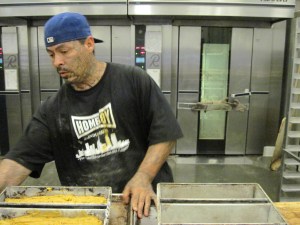
Marcos working at Homeboy Bakery


Norma Robles Gillette explaining the ins and outs
On Saturday my team met with Norma Robles Gillette, Executive Assistant of Homeboy Industries. Our assignment is to pick a story angle on re-entry, and Homeboy is the largest gang intervention program in the United States. Re-entry is a hot topic now because our project advisor Celeste Fremon explained how supporting prisoners is expensive in general, and more specifically, according to Los Angeles Times (May 24, 2011), “The court gave the state two years to shrink the number of prisoners by more than 33000.” While people wrongly jumped to the conclusion that prisons would release prisoners willy-nilly into communities, the more logical and probable result of this ruling will be that the state will have to figure out how to reduce recidivism, or re-entry.
One of the main difficulties with re-entry is that many prisoners have a hard time adjusting to their newfound freedom. For many, all they know is the gang life. It’s easy and likely that they will violate their parole just by hanging out with family or friends. Many have a difficult time finding work with police records, tattoos and a lack of education. Homeboy Industries is stepping up to the challenge to help homeboys stay out of prison. It offers tattoo removal, a slew of classes (I’m sad I will miss the “Dance To The Groove” class, but it meets Tuesdays from 3:30-4:30.), therapy, counseling, career development and more. Norma shared several success stories of ex-prisoners who work for Homeboy or hold jobs in the community. Homeboy has an on-site bakery (We walked away with gratis bread.) and Homegirl Café and Catering.
This story may not be for everybody. There are people who have no compassion for anyone associated with gang life. When asked if she ever had to defend Homeboy to naysayers, Norma nodded her head immediately, but responded that the amount of criticism has lessened over the years. Some people think helping ex-prisoners is a waste of time and money, while others would argue that to not help would be a bigger waste of resources. Celeste told us that California has the highest recidivism rate in the country.
Homeboy has inhabited its large, yellow, modern-looking building for four years. The café is busy every day – even on weekends when Homeboy is closed – and the gift shop was bustling when we were there. In June of this year, Homeboy Diner opened in City Hall, and Norma said that Homeboy is fielding offers for more locations. Norma also spoke about a standing ovation Father Greg Boyle, the founder of Homeboy, recently received from law enforcement at a speaking engagement. This, she said, was something new because police officers (but not all of them) had not always been supportive of Homeboy in the past.
When we film this Thursday, there is a yoga class at 3:45 and a physical training class at 3. I might focus on some aspect of physical movement. Maybe it helps with anger management? I will e-mail Norma now and ask who teaches the yoga class. Volunteers who are part of the re-entry program teach many of the classes. On Thursday we have interviews set up with four men who are part of the program, and Norma is searching for a woman who will speak to us as well.

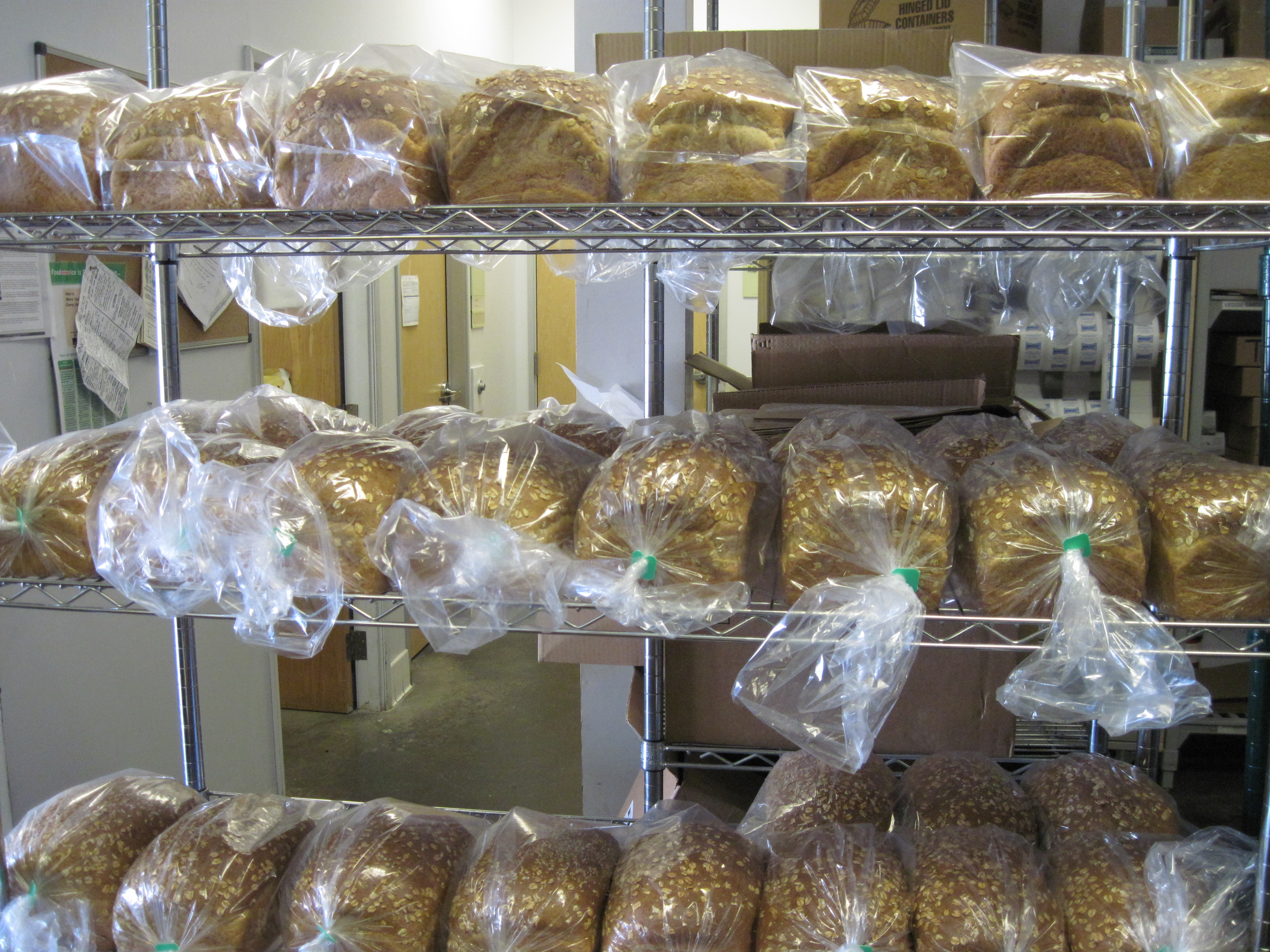
Bread from the bakery

Herbs hanging on the wall in the outdoor garden

Art on the wall near the counselors' offices
 Jessica Koslow