Miss Prissy and I were interviewed about “The 818 Session,” which screened at LACMA on June 29 as part of Dance Camera West, by Jeannette Ginslov of MoveStream.
Miss Prissy and I were interviewed about “The 818 Session,” which screened at LACMA on June 29 as part of Dance Camera West, by Jeannette Ginslov of MoveStream.

Krystle Bueno, center, and other cast members rehearse “BEauty.” (Irfan Khan, Los Angeles Times / June 21, 2012)
Many of the images in last year’s “Beauty CULTure” exhibition at the Annenberg Space for Photography provoked discussion: the blank stare of a child beauty contestant, a pair of taut lips being poked with a surgeon’s needle. The exhibition touched on issues of vanity, acceptance and self-worth. After catching the show, a handful of dancers from the urban dance collective Culture Shock L.A. were inspired to put their own spin on the concept. This Friday at the Ford Amphitheatre, they will premiere “BEauty,” featuring their own work alongside contributions from contestants of “America’s Best Dance Crew,” guest MCs, and actress and Culture Shock L.A .board member Tamlyn Tomita.
For 19 years, Culture Shock L.A.’s main focus has been on outreach and education. The nonprofit community dance organization offers in-school, after-school and public classes in urban dance styles, mostly in neighborhoods lacking arts education programs. Armed with music and dance, they aim to cultivate dignity and combat stereotypes. In 2005, the collective decided to produce benefit shows. “BEauty” will be its eighth, and its third big production this year.
Allison Tanaka is one of Culture Shock L.A.’s co-executive directors. She is slight, almost fragile. One week before “BEauty” premieres, she is gliding graceful as a feather …
Read full article at latimes.com

The food at B+M emulates art, with each dish becoming prettier than the next. (Ximena Herschberg/Neon Tommy)
It’s hard to find Brick + Mortar; so the packed tables must mean good food.
Located on Main Street in Santa Monica, behind Ben & Jerry’s, the gastropub is adjacent to the Edgemar Center for the Arts. The two hidden spots rely on word-of-mouth and advertising for business. Keeping customers, however, is another story. Brick + Mortar does not seem to be having problems with repeat business.
According to one amiable server, Salute, the previous wine bar occupying this space, closed it doors on Jan. 29. Just a short stint later, Brick + Mortar had completely renovated opening on Feb 9. Inside, the high ceilings and impressive size of the room give it a wide-open feel, making it great for groups. It’s hard to determine why one restaurant fails and another makes it, and harder still to predict success. Delicious food certainly increases the odds. B+M doesn’t just deliver dishes to your table; I call it food art.
Starting with a puffy pizza dough loaf and a pot of hummus …
Read full article on NeonTommy.com.
 Jessica Koslow listens as Sarah Reich talks about the trouble tap dancers have earning a living and achieving fame. But the 22-year-old Los Angeles native is not stepping away from her big tap family.
Listen to podcast at Annenberg Radio News Detours
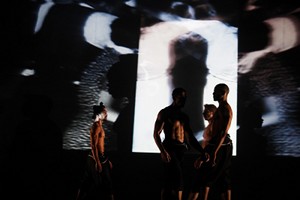
Cedar Lake Contemporary Ballet performs Alexander Ekman’s “Tuplet” at UCLA Live on April 28. / Photo courtesy of UCLA Live
Several times on April 28, Benoit-Swan Pouffer, the French-born artistic director of Cedar Lake Contemporary Ballet, walked through the lobby of Royce Hall looking like he was nervous. He made eye contact with passersby, stopped to chat with other young, stylishly dressed people, but mostly, he looked as if he couldn’t sit still. That evening’s performance was his company’s second of a two-night engagement at UCLA Live. It’s surprising to think Pouffer would be worried, considering he’s incredibly gifted at spotlighting beatific dancers, with just enough impeccable training mixed with the gift of free flow. Cedar Lake’s versatile movers wrap their bodies around choreography like Silly Putty. Toned, flexible and funky, this performance was a prime example of how they ease from one choreographer’s work to the next, shifting effortlessly from one particular style to another. If my attention ever wandered throughout the night’s three sets, it was no fault of the dancers.
Especially not Jon Bond, who makes 28-year-old Swedish choreographer Alexander Ekman’s “Tuplet” piece his own. The scene opens with a white screen, Bond standing as a black silhouette. Every time he moves, a sound escapes. An arm causes a whirring, a foot evokes a beep, and a shoulder lets out a hum. Simple, but evocative. By replacing counts of eight with noises, the body becomes a toy and the movements more relatable. The rhythmic exercise roots dance firmly in everyday life. But there’s nothing ordinary about Bond’s graceful execution. He plays his body like a virtuoso. Or, more likely, Bond acts as DJ, his body acts as turntables that blend and create sounds with every revolution.
“Nothing isn’t a rhythm,” a voice blares out…
Read Full Article on Culture Spot LA
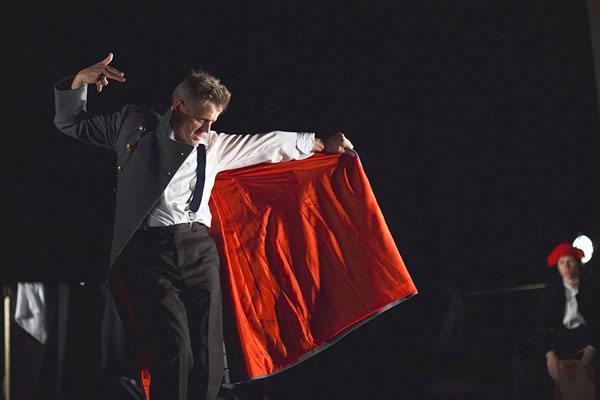
Photo by Maria Baranova
Mikhail Baryshnikov is standing alone on stage. A woman walks toward him. Not a prima ballerina, but a young Moscow-born actress named Anna Sinyakina, or “a mysterious creature,” as Baryshnikov calls her.
He doesn’t lift her over his head. She doesn’t spin swiftly between his fingers. Their bodies are still. He speaks Russian for the first time on stage. This is not the image most people have of Baryshnikov performing. He is now 64, about two decades past the period that he considers the peak of his ballet career.
This week, Baryshnikov kicks off the U.S. premiere of In Paris, an adaptation of a short story by Ivan Bunin, the first Russian to win a Nobel Prize for Literature in 1933, at Broad Stage in Santa Monica. Bunin lived in exile in France after the Russian Civil War (1918-1920) and died in Paris in 1953, never having returned to Russia. Bunin’s background informs In Paris.
Mikhail Baryshnikov; Photo by Annie Leibovitz
“It’s a very simple story about a White Army general who lives in Paris and meets a young woman, also Russian, and they have a certain tragic love affair,” Baryshnikov says via phone from his Baryshnikov Arts Center offices in Manhattan. He speaks in a matter-of-fact tone, which he maintains throughout our conversation two weeks before the Los Angeles opening. The premiere of In Paris took place in Helsinki in August 2011. The show then traveled to the Netherlands, Paris and Tel Aviv, and it’s scheduled to continue on to Berkeley, Italy and New York. The script is in French and Russian, with English supertitles.
Parallels flow between Bunin’s, Baryshnikov’s and the fictional character’s stories. Baryshnikov’s father was in the Russian military …
Read full article on LA Stage Times

Photo by Dan Carino
Though all dance styles are welcome at the 818 Session, the spotlight is on krump, a dance form created circa 2002 in South Central Los Angeles. Dave LaChapelle’s 2005 documentary “Rize” introduced mainstream audiences to krump and clown dancing — the latter adds face paint and costumes and has since subsided in popularity. Krump, however, has managed to gain momentum worldwide.
The economic and social conditions of South Central Los Angeles at the turn of the 21st century contributed to the brewing of repressed emotions and explosive atmosphere that birthed the essence of krump: a defiant attitude, extreme movement, and intense release.
Moving locations from its origins in South Central L.A., the 818 calls North Hollywood home (the session is named after its area code). As B-boy, a former breaker and one of the founders of the 818, explains, a dance community already existed in and near NoHo, which supports the circle: Debbie Reynolds Dance Studios, Millennium Dance Complex, and Evolution Dance Studios are all located in the area. The existence of these studios as well as the relative niceness of the neighborhood makes NoHo a present-day mecca of krump.
“There are no gang bangers out here,” assures Krucial. …
Click here to read the entire article and see more photos by Dan Carino on KCET.org

Photo by Nina Glover
Savion Glover is the best tap dancer alive. His mentor Gregory Hines thought so. On Saturday night, Glover, Marshall Davis and Robyn Watson performed “Bare Soundz” on three mini, square platforms in the form of a triangle on the stage at the Valley Performing Arts Center on the campus of California State University, Northridge. It was as if each audience member had received a golden ticket to attend the greatest tap jam on Earth — 80 minutes of nonstop tapping, including improvised solos, group choreography and trading bars.
Glover champions a new school of tap thought: all tap, all the time. Unlike Hines and another mentor, Sammy Davis, Jr., Glover focuses solely on tap. His feet are his instrument. In fact, his whole body is his instrument. Sometimes he smiles; other times he contorts his face to reflect another emotion or impulse. His hands act as balancers, either swinging by his side or hovering loosely in the air, palms up or down, depending on what he’s trying to say.
Which leads me to two of Glover’s greatest contributions to the art of tap. He wants us to hear the music in tap, but also be aware of the conversation. At times, his tap sequences sound like the heaviest rainstorm. And yet, what we hear is probably different than what he hears, or what he’s telling us. The rhythms he performs differ so subtly, it’s difficult for the average listener to comprehend just how sophisticated his sense of timing is and how complicated his thoughts are. His tapping has reached a level beyond entertainment. In Glover’s capable hands, and those of his partners on stage, tap becomes a form of communication, an outlet for expression, which is best demonstrated when the three dancers trade bars on the same small platform. They appear to be having a ball, sharing jokes, posing challenges and experimenting with new steps.
After a night of taps pounding and sweat pouring, I couldn’t help but think I had witnessed a cool, new millennium version of the bionic man.
Article on Culture Spot LA
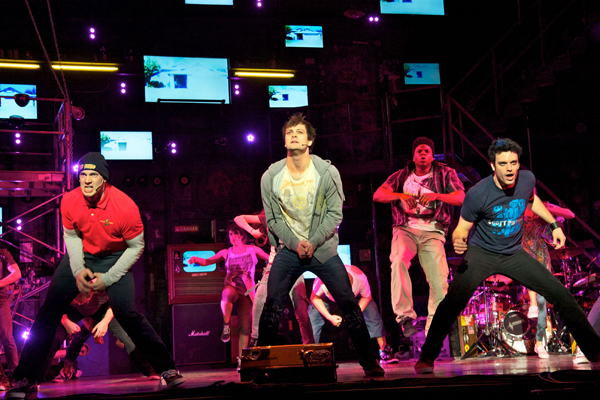
Photo by Doug Hamilton
London-based Steven Hoggett is the proud choreographer of two musicals opening this week: American Idiot at LA’s Ahmanson and Once at the Bernard B. Jacobs Theatre on Broadway. The acclaim is enough to make any artist gloat. But Hoggett keeps his feet on the ground, choosing instead to follow the sage advice of American Idiot and Spring Awakening director Michael Mayer, who told him at the beginning of their production journey, “Nothing is guaranteed.”
This time around, however, continued success for American Idiot is likely. Green Day’s rock opera-turned-musical scored 2010 Tony Awards for sets and lighting and a nomination for Best Musical, and the Los Angeles stop is only one of a string of U.S. dates. This is thrilling for a choreographer who had never worked on a show in America.
“I felt incredibly honored,” says Hoggett, regarding Mayer’s decision to tap the choreographer’s skills for American Idiot. “I did get elevated from Michael’s decision to pluck me from London and throw me into a room full of rowdy, testosterone-driven kids.”
At first, Hoggett felt just personally privileged. After traveling to Manhattan, however, and seeing firsthand how many people Mayer knew and had worked with, and hearing about the scores of people who had asked about his job, he was “absolutely delighted.”
“There were lots of people who were, a) very qualified, b) very exciting choreographers, and c) American — and maybe massive Green Day fans,” says Hoggett. “I was aware of having stepped to the front of what was a very prestigious queue.”
Relatively unknown in America, Hoggett…
Full article on LA Stage Times