Mikhail Baryshnikov – A Russian “In Paris”

Photo by Maria Baranova

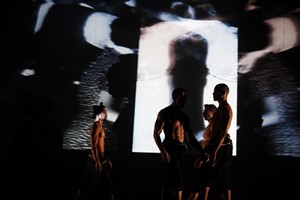
Mikhail Baryshnikov is standing alone on stage. A woman walks toward him. Not a prima ballerina, but a young Moscow-born actress named Anna Sinyakina, or “a mysterious creature,” as Baryshnikov calls her.

He doesn’t lift her over his head. She doesn’t spin swiftly between his fingers. Their bodies are still. He speaks Russian for the first time on stage. This is not the image most people have of Baryshnikov performing. He is now 64, about two decades past the period that he considers the peak of his ballet career.

This week, Baryshnikov kicks off the U.S. premiere of In Paris, an adaptation of a short story by Ivan Bunin, the first Russian to win a Nobel Prize for Literature in 1933, at Broad Stage in Santa Monica. Bunin lived in exile in France after the Russian Civil War (1918-1920) and died in Paris in 1953, never having returned to Russia. Bunin’s background informs In Paris.

Mikhail Baryshnikov; Photo by Annie Leibovitz

“It’s a very simple story about a White Army general who lives in Paris and meets a young woman, also Russian, and they have a certain tragic love affair,” Baryshnikov says via phone from his Baryshnikov Arts Center offices in Manhattan. He speaks in a matter-of-fact tone, which he maintains throughout our conversation two weeks before the Los Angeles opening. The premiere of In Paris took place in Helsinki in August 2011. The show then traveled to the Netherlands, Paris and Tel Aviv, and it’s scheduled to continue on to Berkeley, Italy and New York. The script is in French and Russian, with English supertitles.

Parallels flow between Bunin’s, Baryshnikov’s and the fictional character’s stories. Baryshnikov’s father was in the Russian military …

Read full article on LA Stage Times

Krump Pt. 2 on KCET

Photo by Dan Carino

Though all dance styles are welcome at the 818 Session, the spotlight is on krump, a dance form created circa 2002 in South Central Los Angeles. Dave LaChapelle’s 2005 documentary “Rize” introduced mainstream audiences to krump and clown dancing — the latter adds face paint and costumes and has since subsided in popularity. Krump, however, has managed to gain momentum worldwide.

The economic and social conditions of South Central Los Angeles at the turn of the 21st century contributed to the brewing of repressed emotions and explosive atmosphere that birthed the essence of krump: a defiant attitude, extreme movement, and intense release.

Moving locations from its origins in South Central L.A., the 818 calls North Hollywood home (the session is named after its area code). As B-boy, a former breaker and one of the founders of the 818, explains, a dance community already existed in and near NoHo, which supports the circle: Debbie Reynolds Dance Studios, Millennium Dance Complex, and Evolution Dance Studios are all located in the area. The existence of these studios as well as the relative niceness of the neighborhood makes NoHo a present-day mecca of krump.

“There are no gang bangers out here,” assures Krucial. …

Click here to read the entire article and see more photos by Dan Carino on KCET.org

Savion Glover’s “Bare Soundz”

Photo by Nina Glover

Savion Glover is the best tap dancer alive. His mentor Gregory Hines thought so. On Saturday night, Glover, Marshall Davis and Robyn Watson performed “Bare Soundz” on three mini, square platforms in the form of a triangle on the stage at the Valley Performing Arts Center on the campus of California State University, Northridge. It was as if each audience member had received a golden ticket to attend the greatest tap jam on Earth — 80 minutes of nonstop tapping, including improvised solos, group choreography and trading bars.

Glover champions a new school of tap thought: all tap, all the time. Unlike Hines and another mentor, Sammy Davis, Jr., Glover focuses solely on tap. His feet are his instrument. In fact, his whole body is his instrument. Sometimes he smiles; other times he contorts his face to reflect another emotion or impulse. His hands act as balancers, either swinging by his side or hovering loosely in the air, palms up or down, depending on what he’s trying to say.

Which leads me to two of Glover’s greatest contributions to the art of tap. He wants us to hear the music in tap, but also be aware of the conversation. At times, his tap sequences sound like the heaviest rainstorm. And yet, what we hear is probably different than what he hears, or what he’s telling us. The rhythms he performs differ so subtly, it’s difficult for the average listener to comprehend just how sophisticated his sense of timing is and how complicated his thoughts are. His tapping has reached a level beyond entertainment. In Glover’s capable hands, and those of his partners on stage, tap becomes a form of communication, an outlet for expression, which is best demonstrated when the three dancers trade bars on the same small platform. They appear to be having a ball, sharing jokes, posing challenges and experimenting with new steps.

After a night of taps pounding and sweat pouring, I couldn’t help but think I had witnessed a cool, new millennium version of the bionic man.

Article on Culture Spot LA

“American Idiot” at Ahmanson

Photo by Doug Hamilton

London-based Steven Hoggett is the proud choreographer of two musicals opening this week: American Idiot at LA’s Ahmanson and Once at the Bernard B. Jacobs Theatre on Broadway. The acclaim is enough to make any artist gloat. But Hoggett keeps his feet on the ground, choosing instead to follow the sage advice of American Idiot and Spring Awakening director Michael Mayer, who told him at the beginning of their production journey, “Nothing is guaranteed.”

This time around, however, continued success for American Idiot is likely. Green Day’s rock opera-turned-musical scored 2010 Tony Awards for sets and lighting and a nomination for Best Musical, and the Los Angeles stop is only one of a string of U.S. dates. This is thrilling for a choreographer who had never worked on a show in America.

“I felt incredibly honored,” says Hoggett, regarding Mayer’s decision to tap the choreographer’s skills for American Idiot. “I did get elevated from Michael’s decision to pluck me from London and throw me into a room full of rowdy, testosterone-driven kids.”

At first, Hoggett felt just personally privileged. After traveling to Manhattan, however, and seeing firsthand how many people Mayer knew and had worked with, and hearing about the scores of people who had asked about his job, he was “absolutely delighted.”

“There were lots of people who were, a) very qualified, b) very exciting choreographers, and c) American — and maybe massive Green Day fans,” says Hoggett. “I was aware of having stepped to the front of what was a very prestigious queue.”

Relatively unknown in America, Hoggett…

Full article on LA Stage Times

Ronald K. Brown’s “Evidence, A Dance Compay”

Photo by Kurt Leggard

I often wonder, which is harder: exhibiting refined technique accrued from years of study, or grooving effortlessly to a beat with natural grace and impeccable rhythm? The answer depends on whom you ask. As I watched Ronald K. Brown’s “Evidence, A Dance Company” on March 9 at the Ahmanson Theatre, this question popped into my head. The 10 dancers on stage demonstrated hard-earned, well-polished talent. Leading the charge, however, was their mastery of establishing a visible connection with the music, of riding the tempos with soulful impact.

This seems to be part of the choreographer’s mission, and kudos to Brooklyn-based Brown for combining vernacular with modern, African, Latin American and Caribbean dance. Brown’s work has one foot firmly rooted in the past, while the other is in step with the present. Proving himself a risk taker, he chooses to elevate everyday movement to the professional stage.

A dance instructor recently informed me his own teaching process relies on his students’ intelligence upon arrival in his classroom, intelligence they have gathered by experiencing life. People see their parents or family members dance, attend religious services, boogie at barbeques or Bar Mitzvahs. Everyday movement can inspire dance — even be dance. The show’s first act, “Ebony Magazine: To a Village” (1996) is a perfect illustration. The audience feels as if it is observing an intimate conversation the dancers are conducting with themselves and each other using body motion in lieu of words.

Stevie Wonder’s classic catalog powers the second act: every song in “On Earth Together” (2011). Spectators bob their heads to “Living for the City” and romantically reflect on “You and I.” Brown and his nine counterparts flirt with interpreting Wonder’s music, grounding their movement in real-world reflections. Brown’s work is refreshingly accessible.

Some people attend dance to be wowed by physical feats only a select few can do. “Evidence’s” performance offers a more humanistic element. Nothing expresses this more than Brown’s own smile, a wide grin that beams infectious joy and sweet satisfaction. He’s not as young as the rest of his crew (he’s 46), but he exudes a command of his own action and choreography that is unmatched on stage. He owns his work.

In “Grace” (1999), the third set, Brown touches on the sacred. Yet I couldn’t help recall how the first act also has a spiritual tone, or that Wonder imbues “On Earth Together” with ethereal vibes. With dance, it can be hard to decipher the line between the secular and the sacred. The celestial feeling of performing or watching dance can make you forget your feet are on the ground. Perhaps Brown was too ambitious in taking on Stevie. Besides a few missteps, Broadway’s “Porgy and Bess” choreographer brings dance down to Earth.

Article on CultureSpotLA.com

B-boy Roxrite on LAWeekly.com

B-boy Roxrite

Two days after Thanksgiving Day 2011, hardcore b-boy fans poured into Moscow’s Nikulin Circus for the annual Red Bull BC One Championship. The event is one of the largest and best-known international competitions, tagging itself the “Official Breakdance World Championship.” Sixteen of the world’s top b-boys traded rounds of headspins, power moves and freezes in front of an amped crowd of 2,000. Just when it appeared as if Lil G from Venezuela might take the title, or last year’s champion, Neguin of Brazil, a surprise but repeat contender popped up to take home the trophy.

California native Roxrite, aka Omar Delgado, who splits his time between Los Angeles and San Diego, proved to be the best b-boy in the world that night. It had been a long road to victory. After being beaten in the finals of Red Bull BC One in 2007 and 2008 — and not being invited back for the next three years — Roxrite had a lot to be happy about.

To read my entire article on LAWeekly.com, click here

Krump on KCET

Photo by Dan Carino

Around 2:15 a.m. a police car rolls up flashing its siren in a strip mall parking lot in the San Fernando Valley. The stores are closed. Few restaurants are open. The lot is empty, except for silhouettes gathered in a circle under a bright lamp. A parked car blasts hip-hop music through an open door. Some nod their heads to the beat, chest popping and foot stomping, waiting for a turn in the center. Others watch, chat, joke.

The car slowly approaches, then stops. It beams a spotlight in the group’s direction. Catching sight of the cops, a young man pushes the circle open into a half moon, giving them an unobstructed view.

“Let them see we’re just dancing,” he says. As the people part, a lone male krumper pops into view. Ignoring the cops, the dancer throws his arms to the sky, hops on one knee and bounces up again.

“Show them how you roll, Lil’ C,” someone yells from the circle.

If they recognize the soloist, the cops don’t show it. Lil’ C was one of the stars of Dave LaChapelle’s 2005 documentary Rize, and is seen on TV as a guest judge on FOX’s “So You Think You Can Dance.” Just following orders, the cops are determined to shut down the 818 Session, named after its area code. An officer shouts to the crowd through his megaphone that he has received noise complaints.

Lil’ C still doesn’t stop.

To read the entire article on KCET.org and see my re-edited video, click here

Civic Virtue: Watts Here and Now

Though I was born and raised in Los Angeles, I had never seen the Watts Towers, or what amount to 17 steel-and-mortar sculptures created from 1921 to 1954, prior to this Saturday. (For more information on Watts Towers and its creator Simon Rodia, watch “I Build the Tower.”) The extra incentive for my first viewing was a string of events sponsored by Pacific Standard Time, in conjunction with Los Angeles Municipal Art Gallery and Watts Towers Arts Center, starting with an unveiling at 10 a.m. of several O’ Speak, Speak 2 works in the Garden Studio at Watts Towers Arts Center, and ending with a reception for the exhibit, curated by Willie Middlebrook, at 5 p.m. at Cecil Fergerson Gallery at Watts Labor Community Action Committee. Both installments of O’ Speak, Speak 2 honor five women artists: AfraShe Asungi, Margaret Garcia, Noni Olabisi, Toni Love and Dominique Moody.

Curator Willie Middlebrook/All photos by Willlie Robert Middlebrook 3rd

While roaming around the Garden Studio, I was lucky to meet Middlebrook’s son, Willie Robert 3rd. He took me on a brief tour of the studio garden (below).

He also shared with me how he and his father had transported the women’s art pieces from their studios to the gallery and garden (pictures below).

Toni Love

Margaret Garcia

Dominique Moody


Other events over the course of the day at the Watts Towers Arts Center were Short Stories from the Watts Writers’ Workshop and “The Early Days In Watts,” Reflections and Remembrances with Kamau Daáood Ojenke, Wanda Coleman, Otis O’Solomon and Erin Aubrey Kaplan.

At 2 p.m., Barbara Morrison, a 30-year jazz and blues veteran, serenaded a motley, spirited crowd in darkness on the stage of the WLCAC Bradley Multi Purpose Center (aka senior center). Being in a wheelchair didn’t stop her from getting people up from their seats to do the Electric Slide. Here Barbara sing:

I didn’t stay for the reception at Cecil Fergerson Gallery, but I could tell the night was only going to get more interesting. Starting around the same time as Morrison’s performance, hundreds of punk-styled Latino youth were being dropped off for an outdoor concert right next door to the gallery. A mosh pit was in full force by 3 p.m. That two disparate worlds can exist so closely to each other midday is part of L.A.’s unique charm.

Garden Studio works remain until Feb. 12. WLCAC Cecil Fergerson Gallery exhibition closes March 16.

Forever Flamenco

Ricardo Chavez / photo by Bruce Bisenz, courtesy of Fountain Theatre

Sitting a few rows back from the stage at Barnsdall Gallery Theatre watching the Fountain Theatre’s monthly showcase of “Forever Flamenco!” this past Sunday, I was reminded of krump dancing. Let me explain. Since September I have been attending a krump session — a circle of dancers who congregate every Wednesday at midnight in a parking lot in North Hollywood — observing a style of dance that has its roots in South Central Los Angeles. If you saw Dave LaChapelle’s 2005 documentary Rize, you know what I’m talking about. If not, what brought me back to the after-hours dancing at the parking lot was the foot stomping (obviously), but more overwhelmingly, the emotional release the dancers wear on their faces and exhibit in their movements.

Without knowing much about flamenco, I have gleaned enough to offer that the histories of the people who created both art forms are similar in enough ways to inspire movement of such emotional magnitude. Both African Americans and Gypsies are historically oppressed groups of people who have expressed their experience via their bodies. Every foot slam, hand clap and outstretch of an arm delivers you to a different memory. The feelings that overcome you may not be the same ones the dancers express, but they serve the same purpose: They make you feel alive and connect you with humanity.

A flamenco show is an all-over-body experience. The dancers’ faces contort with feeling, their arms gracefully strike controlled poses in the air, and their feet pound the stage like tap dancers. Even the costumes — with ruffles, wraps, polka dots, lace, hot pink flowers and long trains — get in on the dramatic action. Illuminating it all is the music, which preceded the dance.

Singer Jesus Montoya’s classically scruffy, aching, heart-wrenching vocals powered the night of flamenco. Accompanied by guitarist Juan Antonio Gomez and percussionist Gerardo Morales, the trio had a jolly good time throughout the performances, laughing and calling out to the dancers and each other. It was almost as if Montoya were trying to get the dancers to crack a smile.

But that’s one of the beauties of a flamenco show — the audience and band interaction. (Another wonder is the constant hand clapping, which seems to be an unspoken code I can’t figure out.) Not only do the musicians yell out encouraging words (most often, “Olé!”); audience members yell out snippets in Spanish whenever it strikes their fancy. After an especially emotional stomp, or long and fast footwork set, the audience and musicians erupt with pleasure.

The climax of the night came after Lakshmi Basile finished her solo, “Fondo del Mar (Depth of the Ocean) Solea.” Her performance appeared cathartic — for her and the audience — as if there were no end to her emotional release, or ours. Just when you thought a flamenco dancer has finished a performance, they rev back up for a little bit more. Basile’s exertion was so complete, one of her clips went flying out of her hair. Olé!

While at times the Barnsdall Gallery stage was swirling with somber, it was mostly a festive atmosphere. Ricardo Chavez, the long male dancer, looked like he stepped out of the pages of GQ. I wasn’t surprised to hear that the woman sitting behind me takes his class in Santa Ana.

At the end of the night, the performers invited anyone who wished to come up on stage and dance in a circle they had formed. Much like the krump session I attend weekly, this is a space that encourages improvisation and freestyle, where the dancers share moves and challenge and inspire each other. I’ve seen this done at tap shows too, and this spirit exemplifies dance communities at their best.

For more information about the next “Forever Flamenco!” show, visit fountaintheatre.com.

Story on Culture Spot LA

Tagged , ,