Author Archives: jessicakoslow

Tecnologia Filosofica

Italian dance group Tecnologia Filosofica

Every aspect of Tecnologia Filosofica’s Friday night performance felt surreal, from the venue – Theatre Raymond Kabbaz, which is attached to Le Lycée Français de Los Angeles – to the absence of English and the musical presence of a duo that resembled a tacky Las Vegas nightclub act. It was as if the price of admission bought you a ticket to another country. Flashing with European artistic sensibilities, “Canzoni del Secondo Piano” left many (Americans) in the audience amused and mystified. One thing was (pretty) clear: The quirky, nonlinear performance highlighted the happenings on the second floor of an apartment complex.

For more than one hour, Turin, Italy’s Tecnologia Filosofica accented the ordinary, making the particularities of living in cramped quarters relatable to all who have experienced it. Without words, the two female and three male dancers conveyed what it is like to flirt and socialize with, bump into, and feel crowded by neighbors, but also, in the midst of it all, feel totally alone. Welcome to the ups and downs of apartment dwelling.

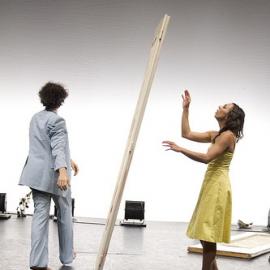
Many of the show’s scenes were odd — perhaps because the irony was French and Italian, as were the songs accompanying each piece, and Americans aren’t always on the same humor page. Yet that didn’t stop the audience from thoroughly enjoying the kookiness on stage. One female, Francesca Cinalli, swung an apple on a string, trying to take a bite. She wore a yellow dress from which her nipple often poked out. Another woman, Elena Valente, clamped a celery stalk between her lips. Both ladies seemed to be longing for love, and not getting it from any of the males, who were engaged in what looked like a friendly game of Twister. When one of the male dancers, a playboy-ish Renato Cravero, finally took notice, he and the celery stalk-ing woman joined together, entangled in an absurd display of lovemaking.

Even more bizarre were the singer, Francesca Brizzolara, dressed in fishnets, black knee-high boots, a miniskirt, and a leopard-print coat with two rollers in her disheveled hair, and the musician, Paolo de Santis, a tad more flashy with black leather pants, a black-and-white-print button-down, and a cheesy mustache. The two seemed plucked right out of a dive bar in any down-on-its-luck town, making funny faces and even sillier gestures to the crowd and into a video camera in front of them. She sang in French and Italian, while he tickled computer keys and played a kazoo.

The most precious part about “Canzoni del Secondo Piano” was how unprecious it was. The piece celebrated average bodies and everyday senses of rhythm. Some people like to move. Some are really good at it. These dancers did not perform anything amazing or near impossible. Instead, they had fun playing with beats and moving in unconventional ways. That makes them dancers. For Americans, who have become used to viewing spectacles and feats of grandeur, it’s refreshing to see people making a dance out of everyday life.

Article Posted on Culture Spot LA
From Lagos to LA, Sahr Ngaujah Plays Fela!

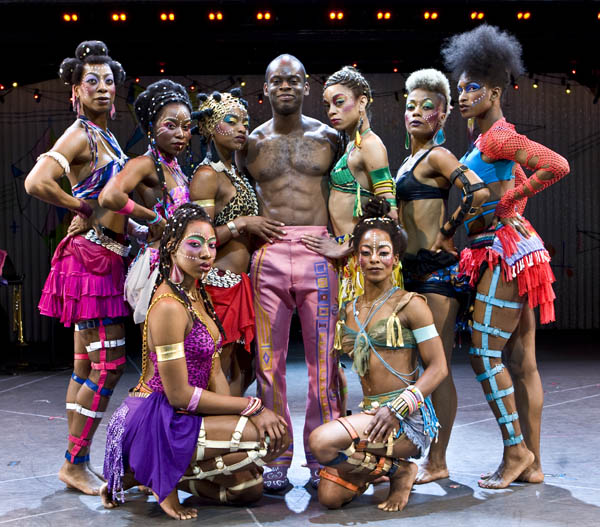
Cast of "Fela!" / Photo by Tristram Kenton

Wow. I saw “Fela!” last night at the opening in Los Angeles. But before I did, I interviewed Sahr Ngaujah, who portrays Afrobeat legend and political activist Fela Anikulapo-Kuti, and has since the show’s 2008 Off-Broadway debut, and LA Stage Times published the article. The show was amazing as was Sahr. Stay tuned for my review, which will be posted shortly.

Locking in LA Weekly

My latest Know Your L.A. Hip-Hop Dances blog in LA Weekly on locking.

Multimedia elements for JOUR 592

DancesMadeToOrder: “Pursuit”

Antics Performance at J.U.i.C.E. 2011:

Snoop Dogg

My latest Know Your L.A. Hip-Hop Dances LA Weekly blog post on the Crip Walk.


Tagged , ,

Hip-Hop Dance Glossary on KCET

Bradley Rapier/Photo by Levi Walker

Bradley Rapier, founder of the Groovaloos and street dance instructor at various locations, including University of Southern California, illustrates some hip-hop dance styles, from popping to party, while one of his students shows off his breaking skills. For more information on the Groovaloos and Bradley, visit bradleyrapier.com, groovaloo.com and groovaloos.com.

Breaking: Emerged from the South Bronx in the early ’70s and revolves around of a number of movements, mainly Toprock, Uprocking, Power Moves, Footwork and Freezes.

Locking: In the late ’60s in Los Angeles, while trying the Funky Chicken, Don Campbell inadvertently created what is now known as a “locking” motion, or freezing to the beat. The art form is loose and extremely funky, yet crisp, strong and athletic at the same time.

Party: A variety of simpler dances reflecting the music and culture of the time that influence the larger street dance disciplines with names like the Freak, the Rock, the Gigolo, Running Man, Roger Rabbit, Robocop, Rooftop, Reject and the Dougie.

Popping: The contraction of muscles to create a pop or hit with the body, hailing from Fresno in the mid-late ’70s.

Popping – Electric Boogaloo Style: Adds twist-o-flexs, rolls of the hips, knees, legs and head, and boog style to the vocabulary of popping.

Rocking: A style of dance that preceded and greatly influenced breaking from New York City, specifically Brooklyn, which features a back-and-forth rocking movement than often accompanies foot shuffles, spins, turns, freestyle movements and a four-point, sudden body movement called “jerk”.

Article on KCET

Tagged , , ,

Meet Machine Gone Funk

When Poppin’ Pete of the Electric Boogaloos gives your group praise, that’s a very good co-sign. “What I love about these cats is that they take a lot of different styles from the Bay Area to Southern and Central California and combine them,” Pete states on one of Machine Gone Funk’s self-made videos. “Each one of these cats has their own feel, and they are definitely doing their thing on the dance floor.”

Machine Gone Funk began to take shape in the Bay Area in 2003. Bumping into each other at various street dance events, the poppers became interested in forming a group to practice together, inspire each other and create routines. Instead of being the “one popper in a b-boy crew,” Machine Gone Funk wanted to develop a popping group and mirror some of the collectives they admired.

The list of Machine Gone Funk poppers is long: Nikodemus, Boogaloo Pimp, Bionic, Kazoo, Slim Boogie, J Smooth, Kid Boogie, Jr Boogaloo and Pharside. They also have their own personal music producer, Fingazz. While the majority of the dancers live in Los Angeles, Jr Boogaloo calls San Diego home.

“We got along,” says Nikodemus via telephone from the apartment he shares with Kid Boogie in Norwalk. “We’re all from different ethnicities and backgrounds, and we already had our own dance flavors established. A lot of us were competition winners, but we didn’t get together to be the best group. We got together as friends and to do the dance that we love to do, and we work well together.”

The funky bunch can perform with anywhere from two to 12 of its members. For the J.U.i.C.E. Hip-Hop Dance Festival, Kid Boogie, Bionic and Slim Boogie represented the Funk. Dancing all at once and then breaking into solos, the three made the crowd feel the music, which is one of their aims.

“We want to do what we love, share it with everyone and make them enjoy what we do too,” says Nikodemus. “Popping is a very musical dance. We want people to view the music through our bodies. That’s the main goal, to show music through our bodies and give them the feeling we have when we dance – a cool, fun feeling. It’s not the same as, say locking that makes you feel happy. This is a cool feeling.”

“When we perform for people who don’t know the dance so much, we do add more of a crowd-pleaser type of thing,” admits Nikodemus. “But when performing for dancers, we try to push the boundaries of what we do as dancers, while keeping the true essence of the dance. That’s always our goal to this day.”

During Machine Gone Funk’s performance at J.U.i.C.E. Kid Boogie held up a sign that read, RIP Skeeter Rabbit, one of their mentors and a pioneer of the art form who died in 2006. Kid Boogie has Skeeter Rabbit’s name tattoo’d on his chest. The group often dedicates its performances to Skeet and another group member, Tapu, who died in a car accident.

It’s a Monday night, and the guys are gathered in Norwalk for their weekly practice.
J-Smooth lives close by, as does Hugo, aka Mr. Smooth, another of their mentors and a friend of the Electric Boogaloos. Tonight they’ll get down on the apartment complex’s racquetball court. Often, they try to make it to Homeland Cultural Center in Long Beach to practice, or they travel to the homes of others members in Van Nuys or West Covina.

According to the group, what makes them unique is that each member contributes their ideas, and the result is “taking the dance to a place that hasn’t been seen before.” They also produce entertaining videos that showcase their dancing abilities throughout gritty urban landscapes that match the intensity of their moves. “We all know how to film dance because we’re dancers,” states Nikodemus. “We have a guy who has filmed the last couple of videos, Rod from Immortal Clothing, but Machine Gone Funk is the director.”

As for the future of the Funk, all of the dancers realize living in the U.S.A. presents a major challenge. “All of us are striving to dance full time and most of us do, but it can always be better, especially in the U.S.,” explains Nikodemus. “If we were living in Japan, Korea or France, it would be a full-time job. In Korea, it’s easier because the government supports dancers. There are professional dance teams that get paid just like professional baseball teams here. In France, the government supports dancers. It’s a lot harder to live as a dancer here doing what we do. But we will always be dancing, doing what we do, and influencing the world with our dance and positive energy.”

For more information, visit facebook.com/machinegonefunk.

Posted on KCET

Tagged ,

Meet Lux Aeterna

Jacob “Kujo” Lyons is one of the artistic directors of J.U.i.C.E. Hip Hop Dance Festival. He is also the founder of Lux Aeterna, a group that has performed in the festival each year. This past September, Lux Aeterna’s piece was dominated by incredulous feats of physical strength, flexibility and grace. The five seemingly superhuman men and women balanced on each other’s body parts and lifted each other in jaw-dropping formations, winding and twisting around each other like ninjas of steel.

Lyons is the fearless leader of Lux as well as a member. He’s also hard of hearing: completely deaf in one ear and over 50% deaf in the other, though you’d probably never know it just from seeing him dance. His controlled, Cirque-like style includes elements of ballet, modern, acrobatics and capoeira. Yet Lyons is quick to point out that he is a b-boy first. Powered by his love of breaking, he started Lux Aeterna while enrolled at California State University, Northridge in 2006 with a central goal in mind: To elevate the hip-hop dance forms he participated in personally to the level of fine/classical art.

In other words, he wanted hip-hop dance to be considered timeless, as is ballet or the much younger modern. “Timeless aesthetics don’t look antiquated. They can be continually adapted to fit contemporary circumstances and themes while still using vocabulary developed long ago before any of us were born,” Lyons explains.

Lyons firmly believes it is possible for hip-hop to remain relevant. It already possesses one characteristic of classical art: It has the ability to transform. “When you witness a piece of classical art like Mozart or certain paintings or sculptures, you’re transformed in some sort of way,” says Lyons. “Your imagination takes off. The way that you looked at the world prior to witnessing that piece is no longer adequate to view the world after seeing the piece. I want my work to reach that level.”

He continues, “Hip-hop is transformative if you participate in it, but the thing about classical art is that it is not just for the performer. It is for the witnesses to be transformed, motivated, inspired. I think my work could do that for people.”

In the process of creating work he hopes is timeless and transformative, Lyons has birthed his own style of dance: a seamless hybrid in which it is not obvious where one discipline ends and another begins. “I take primarily breaking and integrate it with ballet, modern, acrobatics like gymnastics and capoeira, hand balance and circus types of things. I don’t put styles side by side, but integrate them into something new.”

This is not a far stretch from the beginnings of breaking. “Breaking is not a pure dance form,” says Lyons. “It is a composite of multiple influences that were re-stylized into what it became, very urban and funky. Influences were added in, new ingredients.”

For instance, elements of Bruce Lee, boxing, Russian folk dance, Native American dance, the Nicholas Brothers, and James Brown can all be seen in breaking, as if the founders “put them all into a pot, melted them and turned them into this new dance form that has a new aesthetic,” comments Lyons.

Lyons continues the integrative art of breaking with modern, ballet and even circus. “We created a circus show ourselves,” offers Lyons. “We had a debut in Costa Rica for a hip-hop festival this summer. We closed the fest, and it was quite a surprise for people to see b-boys and b-girls that they had known through the years present a show like this, an urban dance and contemporary circus theater show integrating breaking with modern, intense partner work, and the aerial arts.”

Regardless of where he goes from here, all of Lyons’ work eventually circles back to his love of breaking. “There is no more creative art form than breaking,” he assures. “No form has as much room for creativity and personal growth as breaking does. There are sub-styles of breaking where you have traditionalists, and then at the far opposite end of the spectrum people who integrate everything they can into the dance. Then there’s everything in between. The arguing among the styles has led to an amazing array of dancers. The diversity of the b-boy world keeps me in it.”

In the words of Rakim in “I Ain’t No Joke”: Kujo’s just an addict addicted to breaking. “I love seeing what new moves people are doing every day,” he says. “It’s constant. That’s why I can’t get away from it, and I can’t stop doing it. I’m learning when I’m teaching. The process of discovery is never ending, and I don’t know if you can say that about many other dance forms.”

For more information, visit luxaeternadance.com.

Posted on KCET

Tagged ,

The Evolution of Shyoshi

John Magat, also known as Shy Guy, and Tsuyoshi Takayama are fairly new to the partner thing. The two lockers (lockers as in the hip-hop dance) had known each other from one-on-one battles, but they only linked up this past March when Tsuyoshi was asked to perform at a fundraiser. In June 2011, the two danced together again at the “Keep It Live 3: Locking Showcase,” and decided to form Shyoshi (a combination of their names). At “Keep It Live 3,” Emiko Sugiyama spotted the duo and asked them to apply to perform at this year’s J.U.i.C.E. Hip Hop Dance Festival, which she has produced for two years.

According to Shy Guy, when he first started competing and seeing Tsuyoshi around, it was rare to see other lockers — more people gravitated to popping and breaking. When he did run into other lockers, he noticed they stuck to a distinct style of locking.

“Many people who do our style of dancing, called locking, like to keep it very traditional, the way the original people did it, which is really good,” says Shy Guy. “We show parts of that also, but at the same time we show our interpretation of it.”

Their interpretation of locking has a few influences. For Shy Guy, it’s his friends who do other styles that push him to step outside the box. He’s originally from the Bay area, and his crew, Soul Sector, consisted of dancers who each had their own style, which Shy Guy has not been afraid to incorporate into his own. Another inspiration is music.

“They say music creates the dance,” he offers. “The way that the music moves you. Rather than think of different moves, I like to listen to different types of music. I notice that the movements that I do alter, they change, as the music I listen to changes.”

Shyoshi dance to all types of music: funk, house, hip-hop, break beats. Shy Guy even tried locking to Alicia Keys a few times, and rock ‘n’ roll. The L.A.-based lockers maintain an open mind when it comes to their craft.

When Sugiyama called the group to ask if they would partner with Kiminari and Kairi, two dancers from Hiroshima, Japan, for the upcoming J.U.i.C.E. Festival, Shyoshi obliged. The two sets of dancers were supposed to perform as separate acts, but two of Kiminari & Kairi’s partners ran into problems acquiring visas.

The two groups began working together on a collaborative performance piece via the Internet, aided by Tsuyoshi’s Japanese language skills and their dedication to a common goal. “Our collaboration went along with J.U.i.C.E.’s whole theme of world peace,” says Shy Guy, “and bringing people from around the world together.”

Watching the four dancers boogie to the beat on stage, showing off poppin’, lockin’, and straightforward hip-hop choreography, was a highlight of the festival. On October 7, 2011, Kiminari and Kairi delivered the 1,000 Origami cranes, made by the audience during the festival, to the Children’s Peace Monument in Hiroshima.

The Monday after the J.U.i.C.E. festival, Shy Guy returned to his 9-to-5 in the marketing department of a software company. Tsuyoshi juggles part-time jobs, attends school while also auditioning for industry work.

“For me, there are only two things that you can do if you want to make money dancing,” says Shy Guy. “You can teach or you can do music videos and performances. I’m not really into music videos, and I was a teacher but I wasn’t a very good teacher for a long period of time because I kept changing my style.”

“I still love dance very passionately,” he continues. “I realized I don’t have to be in Hollywood or music videos to be a good dancer. As long as I love my dance, and I’m passionate, and I work hard at it, that’s all that matters. I like working during the day and dancing at night. Right now, I like leading two different lives.”

Shy Guy has come a long way since he received his nickname, and now it seems certain he’s locked into his style of dance.

“A long time ago I was very shy and awkward. I couldn’t look people in the eye,” assures Shy Guy. “When I first started dancing I didn’t have a style. I just did routines and choreography like a lot of dancers out there. But something about it never felt right. The moment I saw my mentor Ceech dancing, I knew that was what I had been looking for, that’s what I wanted to do. He was one of the first lockers I saw, and he’s been a big influence on me. He helped me with coming out of my shell, not just as a dancer, but as a person. Thanks to Ceech, and a lot of other people helped me along the way so I am who I am today.”

Posted on KCET

Tagged ,

Inside the Versa-Style Dance Company

Jackie Lopez loves what she does. Her smile is contagious as she bounces to the pulsing house beat. She moves with passion and grace, in unison with the pack of Versa-Style dancers. It’s a Sunday afternoon, the last performance of a two-weekend run of “Positive Dose.” This is the company’s third self-produced, full-length production since 2007; each placing hip-hop dance within the larger context of the dance world and highlighting the power and meaning of dance within hip-hop culture.

Lopez and her partner Leigh Foaad, aka Breeze Lee, are the artistic directors of Versa-Style Dance Company. Their mission is twofold: They team-teach a community house dance class Fridays at Evolution Studios in Hollywood and work for months to produce hip-hop dance theater, with the overarching goal of spreading positive perspectives on hip-hop culture.

“The whole idea for Versa-Style came about in 2004 when I was in the Department of World Arts and Cultures at UCLA, and I was asked and challenged to articulate what I love so much,” says Lopez in a recent phone interview. “I had a huge passion for social styles, which is the Latin side of me, and hip-hop. I started researching what hip-hop is all about, and why people identify with it so much and love it so much. ”

In 2004, Lopez met Rennie Harris, a pioneering hip-hop choreographer from Philadelphia, who was a guest lecturer/instructor at UCLA. With his encouragement, she started looking into the histories of the different street dance styles. Knowledge is power, and Lopez wanted both.

In the process of studying the dance legends and actually speaking to the living ones, Foaad and Lopez started teaching, and the seeds for Versa-Style were planted. “I feel that hip-hop in the mainstream is viewed one specific way, when there’s so much depth and so much more we could share about the culture,” explains Lopez.

The most vibrant elements of hip-hop culture – the spirit of inclusion, innovation, reverence and authenticity – were on display during “Positive Dose” at the Rosenthal Theater at Inner-City Arts in downtown L.A. Opening the show was video footage of Harris tracing elements of hip-hop dance back to singer and bandleader Cab Calloway, tap dancers the Nicholas Brothers and all-around entertainment phenomenon Sammy Davis, Jr. Next was a visually stimulating lesson on the huge influence of “Soul Train” on hip-hop dance styles. The gift of Versa-Style is it reminds us that dance styles will continue to change based on time, place and space, but they remain in conversation with the culture.

The show also introduced audiences to Versa-Style Next Generation, their junior company. “I used to be a teacher and I have a huge connection with students,” begins Lopez. “We also have a huge following in our Friday classes, and we want to give students an opportunity to perform, to express themselves and feel like a family. Versa-Style is about passing our knowledge on and extending ourselves to the next generation.”

The dance company does actually resemble a family, albeit a very diverse one. According to Lopez, it mirrors the makeup of Los Angeles. All of the Versa-Style dancers are tied to the hip-hop community, most attend b-boy/girl battles and events, and many are students or graduates of UCLA. And as in any family, the challenges for the parents – and kids – are many.

“Basically, Lee and I are not just artistic directors, we’re administrative directors, executive directors, founders and choreographers,” relays Lopez. “The biggest challenge is accommodating everyone’s schedules. We’re not at that point yet where we can pay dancers enough where they don’t have to work other jobs. But we’ve been going strong for five years with only minor company changes. We are fortunate that we have a following of dancers that believe in our mission and what we love to do.”

One day, Lopez hopes to expand the scope and reach of their work. The company just recently secured nonprofit status, and Lopez will soon be exploring and researching another world, that of grants. As the program director for The Flourish Foundation, a local nonprofit arts organization founded by Monica and Phil Rosenthal (creator/executive producer of “Everybody Loves Raymond”), Lopez has already observed the process of applying for grants and scholarships, and knows it is a long and tough road.

“This is something that we hold close to our lives and what we do,” Lopez assures.
“We have a mission about what it is we want to share. Dances are social forms that come from an era of struggle for colored people. With our shows we keep the movement going. We find ways to educate while entertaining.”

For more information, visit versastyledance.com.

Posted on KCET

Tagged ,